


Size an outboard from the boat outward. Read the maximum horsepower, persons and weight marked on the hull, check whether the US federal safe-powering calculation covers it, then subtract motor, rigging, battery and fuel weight from the load budget before comparing engines. The rated maximum is a ceiling produced under light test conditions, not a recommendation for a working boat, so confirm it against the builder's documentation and the engine maker's data.
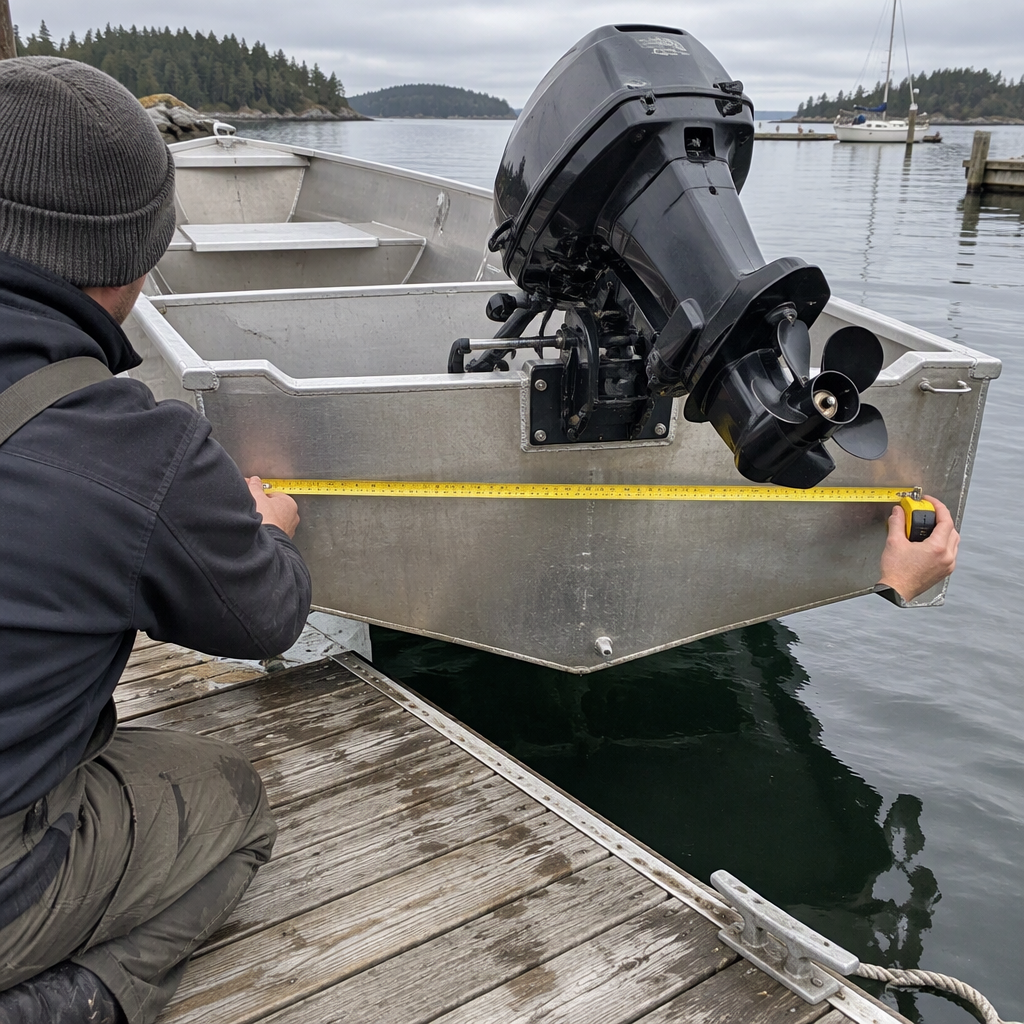
Start With the Boat's Rated Maximum Horsepower, Not the Motor Catalogue
Start with the figures marked on the boat itself, because the US federal safe-powering rules in 33 CFR 183.51 apply to monohull boats under 20 feet that are designed or intended for one or more outboard motors, and exclude sailboats, canoes, kayaks and inflatables. For a boat inside that group, the capacity marking states the maximum horsepower capacity, the maximum persons capacity in persons and in pounds, and the maximum weight capacity. That marked horsepower is a limit produced by the regulation's computation or by its optional performance-test method, so it is a ceiling rather than a target. If your hull is 20 feet or longer, is not a monohull, or was rated outside the United States, treat any horsepower figure as unconfirmed until the builder documents it for your hull.
| Hull and configuration | Rating basis | What to collect |
|---|---|---|
| Monohull under 20 ft, outboard power, not a sailboat, canoe, kayak or inflatable | Computation in 33 CFR 183.53, or the performance-test method for a qualifying boat | Marked maximum horsepower, persons and weight capacities from the capacity plate |
| Monohull 20 ft or longer | Outside the federal safe-powering computation, whose scope stops below 20 ft | The builder's documented horsepower, weight and displacement figures for the model |
| Boat marked as not rated for propulsion by a motor | No outboard horsepower capacity applies | Confirmation of the marking and the intended propulsion type |
| Multihull, sailboat, canoe, kayak or inflatable | Outside the scope of the safe-powering rules | The builder's documentation and the requirements that apply where the boat is used |
If you want to check the arithmetic, the published text of 33 CFR 183.53 contains the factor table, the three formulas used above a factor of 52.5, and the optional performance-test procedure with its test conditions. Read it as a marking rule for boats inside its scope: it does not certify any particular hull, and it does not replace the builder's documentation for your boat.
Treat the marked maximum as a limit, not a shortlist. A rated maximum is the highest power the boat was documented to carry under the computation or the test used for that mark. It does not describe how the hull behaves with a full crew, a deck load or a following sea at that power. If the marked figure is missing, ask the builder for the documented rating.
Step 1: Convert Hull Length and Transom Width Into a Capacity Factor
For a monohull outboard boat under 20 feet, the computation multiplies the boat length in feet by the maximum transom width in feet, and the product is the factor that selects a horsepower figure from Table 183.53. A factor of 52.5 or less reads straight from the table's bands, while a larger factor uses one of three formulas that depend on the steering arrangement, the transom height and the hull bottom.
| Factor or configuration | Horsepower result |
|---|---|
| Factor 0 - 35 | 3 hp |
| Factor 36 - 39 | 5 hp |
| Factor 40 - 42 | 7.5 hp |
| Factor 43 - 45 | 10 hp |
| Factor 46 - 52 | 15 hp |
| Above 52.5, remote steering and transom height of at least 20 in | (2 x factor) - 90 |
| Above 52.5, no remote steering, or transom height under 20 in | (0.5 x factor) - 15 |
| Above 52.5, flat-bottom hard-chine hull | (0.8 x factor) - 25 |
| Flat-bottom hard-chine hull with a factor of 52 or less | Reduce the result by one capacity increment |
Do not use the calculation to uprate a hull that was never rated that way. The computation works from the marked dimensions of a boat built and marked under the rule; applied to a hull built elsewhere, or to a length and transom width you measured yourself, it produces an arithmetic result rather than a rating. Where a result falls close to a band boundary or a formula threshold, read the current published text of the section, and ask the builder to confirm the figure in writing.
Step 2: Spend Load Budget on Payload, Not Just Horsepower
Yes, because the maximum weight capacity marked on an outboard boat is capped at one fifth of the difference between the boat's maximum displacement and its boat weight, where boat weight includes hull, deck and superstructure, permanent appurtenances and full permanent fuel tanks. Persons capacity is then worked out from that weight capacity after deducting the weight of the motor and controls, the dry battery weight and the weight of a full portable fuel tank, and converted into a number of people by a fixed formula. Fitting heavier machinery than the configuration assumes therefore reduces both the payload and the number of people the boat may carry at its rated power.
| Rated power band | Required test weight |
|---|---|
| 11.0 - 22.9 hp | 234 lb |
| 23.0 - 34.9 hp | 350 lb |
| 35.0 - 64.9 hp | 459 lb |
| 65.0 - 94.9 hp | 628 lb |
| 105.0 - 144.9 hp | 723 lb |
| 145.0 - 194.9 hp | 762 lb |
| 195.0 - 209.9 hp | 863 lb |
| 210.0 - 300.0 hp | 914 lb |
These are regulatory test weights used in flotation and safe-loading work rather than the catalogue weight of any named engine: each band combines running weight, rigging and controls, the battery and a full portable tank, as set out in 33 CFR 183.75. Use the band for your candidate power to see roughly how much of the load budget that power class consumes, then replace it with the real engine and rigging weight for the model you intend to fit.
Step 3: Match the Power Band to Duty Cycle and Sea State
The rated maximum is a ceiling, not a duty rating for your working day. Choose the power band from the load you normally carry and the sea state you normally meet, then check that the choice sits inside the marked maximum and inside the remaining weight and persons capacity. Some engine manufacturers publish package performance bulletins, described as test data for a particular boat and engine combination, so ask your dealer whether a bulletin exists for a combination close to yours, and read it as evidence for that package only.
What a rated maximum was tested under. The performance test that a builder may use instead of the computation is run on smooth, calm water with the wind below 10 knots and with no load other than a driver weighing no more than 200 pounds, using a quick-turn test and a test-course method. A rating produced that way describes a light condition, so work out your own case: list the people, fuel, water, gear and added equipment you carry on a normal trip, keep that total inside the marked weight and persons capacity, and if the boat runs heavily loaded in a chop, discuss a lower power band with the builder.
- Set the ceiling from the marked capacities, not from the engine catalogue.
- Set the working power band from your normal load and the sea state you operate in.
- Keep machinery, battery and tank weight inside the weight and persons capacity at all times.
- Record the load case you sized for, so a later repower can be checked against the same numbers.
Step 4: Confirm Transom Height, Steering and Propeller Before Acceptance
Confirm that the boat as delivered matches the configuration the rating assumed: above a factor of 52.5 the formulas distinguish a boat with remote steering and a transom height of at least 20 inches from one without remote steering or with a lower transom. Confirm the propeller against the engine maker's own documentation for your hull and load case, and keep both documents with the boat. For anything you inspect by hand near the engine, the propeller or the transom, switch the engine off and disconnect the battery at the isolator first, and work only through the access the engine maker's manual permits.
- Copy the marked maximum horsepower, the maximum persons capacity in persons and pounds, and the maximum weight capacity off the capacity plate before anything is fitted, and photograph or scan the plate.
- Check the transom height and the steering arrangement actually supplied against the configuration the rating basis assumes: remote steering with a transom height of at least 20 inches, or no remote steering or a transom below 20 inches. The formulas above a factor of 52.5 use different multipliers for those two configurations.
- Obtain the engine, rigging, control, battery and portable tank weights, and compare the total with the required test-weight band for your rated power and with the payload that remains. The regulatory bands combine running weight, rigging and controls, the battery and a full portable tank.
- Switch the engine off and disconnect the battery at the isolator. Then, following the engine maker's and the builder's instructions and only through the access those instructions allow, check the transom mounting hardware, the engine well and the steering clearances.
- Ask the dealer to confirm in writing that the propeller fitted is the one the engine maker's documentation specifies for a hull of this length and weight and for your normal load case, and record the engine model and the propeller part number.
- Sea-try the boat with your normal load before you accept it, note the engine's behaviour at full throttle against the range the maker's manual specifies, and record anything that needs adjustment.
- File the marked capacities, the engine data sheet, the propeller specification and the load case you used, so the next repower starts from the same numbers.
What to Send a Builder or Dealer Before Requesting a Quote
Send the marked capacities, the hull's principal dimensions, the documented weight or displacement, and your load and duty case, so a builder or dealer can confirm a power band and configuration for your boat.
- Boat length in feet and maximum transom width in feet, as marked or as built.
- Transom height, and whether the boat has remote steering.
- Marked maximum horsepower capacity, or the hull's documented rating where no capacity plate exists.
- Marked maximum persons capacity in persons and pounds, and maximum weight capacity.
- Boat weight and, where documented, maximum displacement, so the weight-capacity basis can be checked.
- Expected engine, rigging, battery and portable tank weight for the candidate outboard.
- Normal load case: people, fuel, water, gear and any equipment added after delivery.
- Duty profile: typical hours, working speeds and the sea state you operate in, plus where the boat will be registered and used.
- For a repower: the existing engine model, its weight, and the current propeller and mounting hardware.
Builders publish product ranges rather than sizing tables: the supplier lists aluminium boats, fibreglass boats, landing craft, patrol and pilot boats, passenger boats and steel hull vessels among the vessels it builds. That shows which hull types a yard can supply, not the rated horsepower, displacement or weight of a particular model, so ask for those figures for the exact hull you are considering.
Conclusion
Work in this order: marked capacities, the length-and-transom factor, the weight machinery and tankage consume, the power band your normal load and sea state need, then the installation checks.
- The capacity plate sets the ceiling; the computation shows where that ceiling comes from.
- Engine and tank weight is paid out of payload, not added on top of it.
- Size for the normal load case, not for the light test condition.
If a figure is missing, ask the builder for it rather than substituting a rule of thumb.
Frequently Asked Questions
Most outboard sizing questions come back to three marked figures - maximum horsepower, weight capacity and persons capacity - plus hull length and transom width.
Can I fit a bigger outboard than the capacity plate allows?
No. The marking rule requires the boat to be marked with a maximum horsepower capacity, and that figure is the documented limit for the hull. The federal safe-powering rules exist so that boats are not powered beyond the capacity they were built and marked for. Fitting a larger engine also puts the boat outside the persons and weight capacities on the same plate. If you need more power, change the hull rather than the plate.
My boat is longer than 20 feet - does the federal horsepower formula still apply?
No. The safe-powering computation and its factor table are limited to monohull boats under 20 feet that are designed or intended for outboard power, and boats of 20 feet or more fall outside that scope. Ask the builder for the maximum horsepower it documents for the hull, keep that figure with the boat's papers, and check the requirements that apply where the boat is used and registered.
Why is the capacity reduced for a flat-bottom hard-chine hull?
The regulation treats flat-bottom hard-chine hulls differently from other forms: their figure is (0.8 x factor) - 25 rather than the remote-steering or non-remote-steering formulas, and a reduction of one capacity increment is published where the factor is 52 or less. The practical point for a buyer is that the same length and transom width do not produce the same figure on every hull, so use the row that matches your hull form.
Does the rated maximum horsepower already assume a full load of people and gear?
No. The performance test behind a rating is run on smooth, calm water with the wind below 10 knots and with no load other than a driver weighing no more than 200 pounds. The weight the boat may carry is a separate marked figure, capped at one fifth of the difference between maximum displacement and boat weight. Motor and control weight, battery weight and a full portable tank are deducted before persons capacity is worked out.
How is a twin-outboard installation treated against a single rated maximum?
The capacity marking states the maximum horsepower capacity for the boat. Check the combined horsepower of the engines you intend to install against that figure, and remember that the weight of motors and controls, the battery and a full portable tank is deducted before persons capacity is calculated, so two engines and their rigging consume more of that budget. Ask the builder or dealer to confirm the twin configuration in writing against the boat's marked limits.
Outside the United States, what replaces the federal horsepower calculation?
The US rules are national marking requirements for a defined group of boats and say nothing about ratings issued in other jurisdictions. There is no single worldwide substitute: other countries and regions apply their own recreational-craft, registration and survey requirements, and a hull built for another market may arrive with a builder's rating document rather than a federal-style capacity plate. Ask the builder for the hull's documented rating, and confirm the requirements that apply where the boat will be used.


