


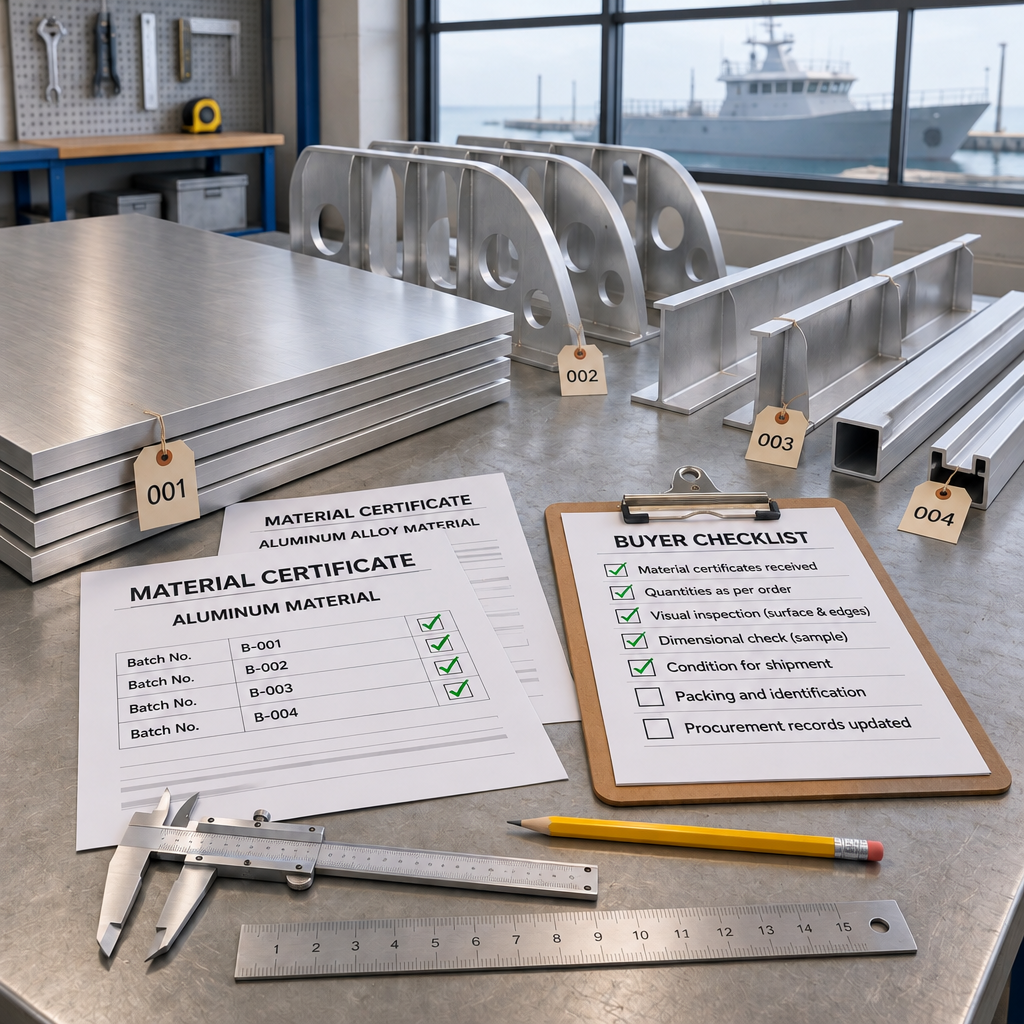
Start with the part’s job, not just the alloy name
For marine aluminum alloy selection, first decide whether the item is sheet, coiled sheet, or plate intended for marine service under a recognized material specification. Then match that material choice to the hull or structural role, because aluminum hull rules may evaluate material, structure, welding calculations, and certification as one connected system.
Buyers often ask for a “marine grade” alloy, but that wording is too loose for procurement. A hull bottom plate, side shell, deck insert, bracket, console support, and superstructure panel do not face the same combination of water exposure, load path, forming, welding, and inspection requirements. The safer commercial question is: what function must this part perform, which material form is being bought, and what documents will prove that the delivered batch matches the specification?
| Selection question | Buyer action | Why it matters |
|---|---|---|
| Is the item hull plating, deck, framing, bracketry, or superstructure? | Define the structural role before approving the alloy and temper. | Hull guidance may treat material, structure, welding, and certification together rather than as isolated choices. |
| Is the ordered form sheet, coiled sheet, or plate? | State the material form in the purchase order when referencing ASTM B928 marine sheet and plate scope. | ASTM B928 covers high-magnesium aluminum-alloy flat sheet, coiled sheet, and plate for marine applications. |
| Will the part be welded, formed, machined, or left as a flat panel? | Ask design and fabrication teams to review the alloy choice before procurement is locked. | Classification guidance for aluminum hulls can include welding calculation approach as part of the hull assessment. |
| Which rule set, class notation, flag, or customer specification applies? | Use official rule platforms to confirm the current edition and previous editions when relevant. | DNV provides a Rules and Standards Explorer for rules, standards, full-text search, previous editions, and cross-references. |
Separate hull plating from structural load paths
Hull plating and structural members should be screened against their load path, arrangement, welding requirements, and classification process, because Bureau Veritas NR561 for hulls in aluminium alloys addresses material, hull structure, welding calculation approach, and classification or certification process for aluminum hull and superstructure work.
Hull plating is a boundary between the vessel and the operating environment. Structural parts transfer and distribute loads through frames, girders, decks, brackets, and superstructure connections. The same alloy designation may therefore require different acceptance checks depending on where it is installed and how it is joined. For operators and dealers, this affects spare-part approval and repair planning. For designers and purchasers, it affects whether the material order can be tied back to drawings, weld details, class review, the intended sea conditions, and the vessel’s stability basis. Treat stability as a procurement interface, not as an alloy label: if a proposed alloy, thickness, structural arrangement, or substitution could change weight distribution, center of gravity, reserve buoyancy assumptions, or the approved stability basis, require naval-architecture or class review before accepting the material change.
| Decision area | Hull plating | Structural parts |
|---|---|---|
| Primary buyer question | Can the plate form, corrosion exposure, and joining plan support the hull envelope? | Can the member carry its assigned load path after forming, cutting, fitting, and welding? |
| Documentation focus | Material form and specification reference for marine sheet or plate should be clear. | Structural role, arrangement, and welding calculation approach should be checked against the applicable class process. |
| Design dependency | Panel size, hull zone, operating profile, and local reinforcement influence the final choice. | Connection details, stiffness, fatigue-sensitive areas, and weld sequence can influence the final choice. |
| Procurement risk | A material that sounds marine-suitable may still lack the required standard edition, certificate, or batch evidence. | A part may be made from an acceptable material form but still be unsuitable if fabrication changes the intended structural behavior. |
When a class or certification pathway applies, use the current rule text and project drawings to confirm requirements before final alloy approval; a public rule-summary page does not by itself prove that a specific vessel, part, or supplier complies.
Check fabrication effects before locking the alloy
Fabrication is part of the alloy decision because aluminum hull guidance can connect material selection with the welding calculation approach and the classification or certification process. A practical RFQ should therefore ask how the alloy will be cut, formed, machined, fitted, welded, inspected, and documented.
Marine aluminum is rarely purchased as a finished decision. It becomes a hull or structural part through shop processes, and those processes can determine whether the selected material remains appropriate for its role. A plate chosen for a flat hull panel may not be the best commercial choice for a tight-formed detail. A structural member may need closer review if it includes heavy weld concentration, complex fit-up, or a connection that controls stiffness and load transfer.
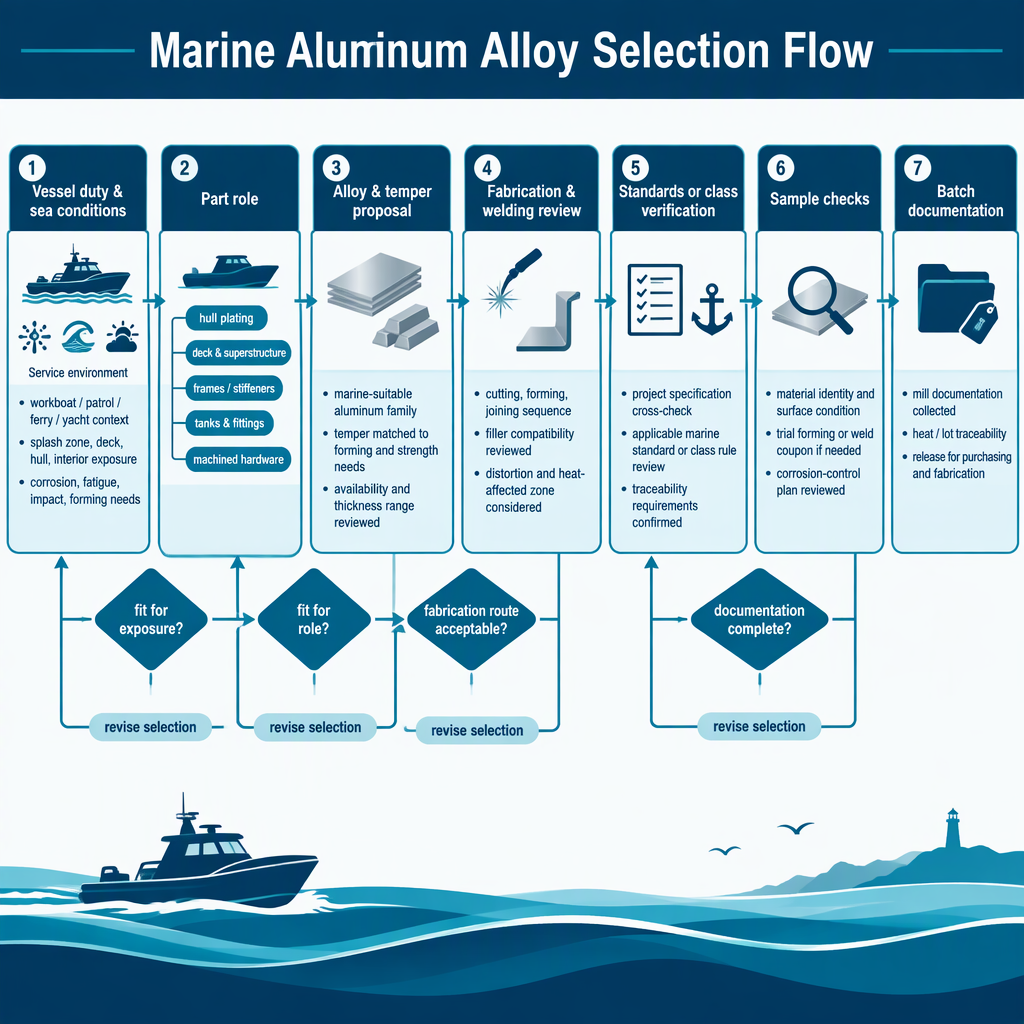
- Map each part to its drawing position, service exposure, load path, and joining method before naming the alloy.
- Ask the designer or class reviewer whether the weld arrangement and calculation approach affect allowable material or temper choices.
- Confirm that forming, cutting, drilling, machining, and fit-up tolerances are compatible with the chosen material form and part geometry.
- Define which sample coupons, trial welds, dimensional checks, or surface inspections the buyer expects before production release.
- Require batch-level records that connect delivered material to certificates, shop travelers, sample results, and final installed parts.
Tie the purchase order to standards, certificates, samples, and batches
A purchase order for marine aluminum sheet or plate can reference ASTM B928 when the buyer needs the publisher’s standard specification scope for high-magnesium aluminum-alloy sheet and plate for marine service. For class rules, use the official DNV rules and standards platform or the relevant class society’s current rule source rather than relying on copied summaries.
The ASTM publisher page identifies ASTM B928 as a standard specification for high-magnesium aluminum-alloy sheet and plate for marine service and shows an active B0928/B0928M-15R23E01 version while the displayed B928-04 page is historical.
Bureau Veritas lists NR561 Hull in aluminium alloys, reference NR561 R05 dated December 2025, as covering general requirements for hull scantling and arrangements with respect to material, hull structure, welding calculation approach, and classification or certification process for hull and superstructure made of aluminium alloy.
For procurement, a standard reference is only the starting point. The buyer still needs enough evidence to connect the delivered material to the order, the order to the design, and the design to the vessel’s intended use. This is where sample testing and batch consistency become commercial safeguards, not paperwork decoration.
- State the exact standard and edition or active version to be used for marine sheet or plate, and avoid citing a historical edition as current without checking the publisher’s status.
- Require a material certificate that identifies alloy, temper, product form, heat or batch number, dimensions, and supplier identity.
- Define sample-test expectations before ordering: certificate review, dimensional verification, surface inspection, trial forming, or weld qualification evidence as applicable to the part.
- Ask how batch numbers will be preserved from incoming material through cutting, forming, welding, and installation.
- For classed or regulated vessels, confirm the current rule edition and any previous-edition relevance through the official rule platform or the appointed surveyor.
- For aluminum hull and superstructure work, make sure material, structure, welding calculations, and certification steps are reviewed together rather than by separate purchasing assumptions.
Use an RFQ checklist to compare suppliers without unsupported claims
YAMANE YACHT is identified on its first-party website as Yamane Ryu Yacht Manufacturing co., LTD. Its aluminum alloy boat category page presents an aluminum alloy boat product category and contact path. When comparing any supplier, use the same RFQ checklist and require documents rather than relying on promotional claims.
A fair supplier comparison should not reward vague statements such as “marine grade,” “premium,” or “custom built” unless the supplier can connect the statement to drawings, material certificates, test records, and batch controls. This is especially important for dealers and operators buying finished boats, as well as designers and purchasers sourcing hull kits, replacement structures, or semi-finished parts.
| RFQ item | Acceptable buyer request | Red flag |
|---|---|---|
| Material identity | Ask for alloy, temper, product form, dimensions, and the marine sheet or plate specification when applicable. | Only a generic “marine aluminum” label is provided. |
| Structural role | Ask the supplier to identify whether the material is hull plating, framing, bracketry, deck, or superstructure and how it ties to the drawing package. | The same material answer is used for every part without structural explanation. |
| Rules and class | Ask which official rule edition, survey process, or customer specification governs the order. | The supplier claims approval without naming the governing document and review path. |
| Samples and testing | Ask for agreed sample pieces, certificate review, and inspection points before bulk release. | Testing is promised verbally but not tied to acceptance criteria or batch records. |
| Batch consistency | Ask how heat, batch, or lot identity will be preserved through cutting and fabrication. | Certificates cannot be matched to finished or installed parts. |
- Send the same part list, drawings, vessel duty, operating waters, and documentation expectations to every shortlisted supplier.
- Request the exact alloy and temper proposal for each hull and structural part, not one blanket material statement for the whole vessel.
- Ask for certificate samples and batch-traceability examples before awarding the order.
- Require written approval for substitutions in alloy, temper, thickness, material form, welding method, or inspection scope.
- Treat first-party website identity as company-identification evidence only; do not treat it as proof of certification, capacity, or project compliance without separate documents.
- Treat a product-category page as an initial category signal, then request the project-specific specification package before procurement approval.
Conclusion
The best marine aluminum alloy choice is the one that can be tied to the correct material form and specification. It must also fit the hull or structural role, welding approach, and applicable classification or certification pathway.
- Begin with use, load path, stability needs, sea conditions, and regulation or class context.
- Separate hull plating from structural parts before comparing alloy proposals.
- Make fabrication review part of the selection process, especially for welded aluminum structures.
- Put standards, sample checks, certificates, and batch consistency into the RFQ before ordering.
FAQs about marine aluminum alloy selection
These questions help operators, dealers, designers, and procurement teams turn marine aluminum alloy selection into a verifiable purchase decision.
What is the best marine aluminum alloy for a hull?
There is no single best answer from the public specification scope alone; the buyer should first confirm the required material form and marine sheet or plate specification. For a classed hull, the final choice should also be checked against hull structure, welding calculations, and the certification process.
Are structural parts selected the same way as hull plating?
No. Structural parts should be reviewed by their load path, arrangement, connection details, and welding approach, while hull plating also has boundary exposure and panel behavior to consider.
When should procurement reference ASTM B928?
Reference ASTM B928 when the order concerns high-magnesium aluminum-alloy flat sheet, coiled sheet, or plate for marine applications and the buyer needs a recognized specification scope.
How should class rules be handled in an RFQ?
Use official class platforms to confirm current rule editions and previous editions when relevant. For aluminum hull work, ask how material, hull structure, welding calculation, and classification or certification steps will be addressed together.
What sample testing should a buyer request?
Request sample checks that match the part risk: certificate review, dimensions, surface condition, forming trial, weld-related evidence, or other agreed inspections. The key is to define acceptance expectations before bulk production, then connect results to the batch records.
How can batch consistency be checked?
Ask the supplier to show how each heat, lot, or batch number will remain traceable from incoming material through cutting, forming, welding, inspection, and final delivery. Certificates should be matchable to actual parts, not stored as disconnected paperwork.
Can YAMANE YACHT be considered for aluminum alloy boat discussions?
The first-party website identifies the business as YAMANE YACHT / Yamane Ryu Yacht Manufacturing co., LTD. Its product-category page includes an aluminum alloy boat category. Buyers should still request project-specific specifications, certificates, sample-test plans, and batch records before any technical approval.


