


Limit galvanic corrosion on a welded aluminum boat by treating the hull, underwater metals, electrolyte, anodes, shore-power connection, and inspection plan as one system: reduce dissimilar-metal contact, isolate where practical, specify a suitable cathodic-protection approach, and keep inspection responsibilities clear before the boat is ordered.
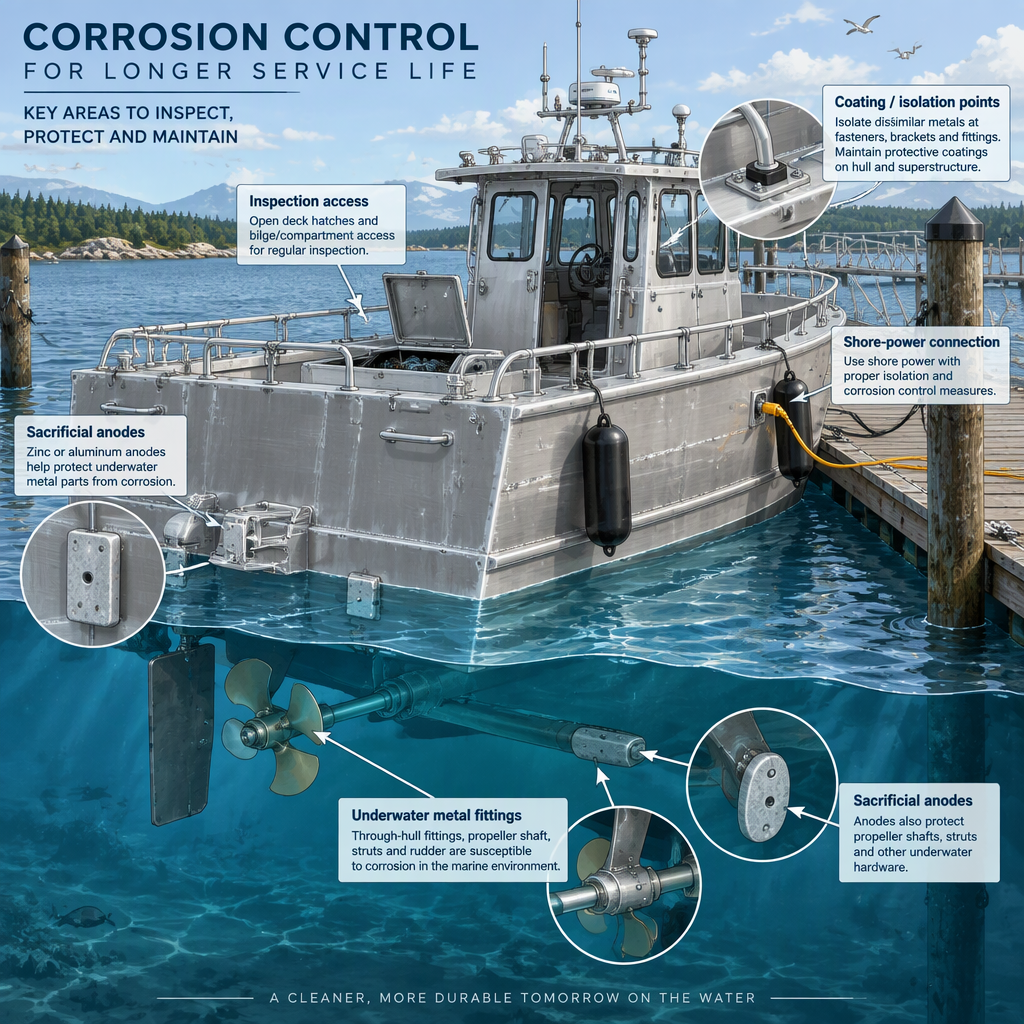
Why galvanic corrosion happens on welded aluminum boats
Galvanic corrosion starts when dissimilar materials are electrically connected in a conductive environment, so the less noble material becomes anodic and corrodes faster.
The AMPP galvanic corrosion explanation describes the basic mechanism: an electrical couple, a corrosive electrolyte, and a metal that becomes the anodic member of the pair.
For a welded aluminum boat, the practical question is not only whether aluminum is present. Buyers should also review stainless fittings, bronze or other underwater hardware, fasteners, electrical bonding, wet bilge areas, paint damage, and any detail that can connect a large cathodic surface to a smaller anodic aluminum area.
Risk points to review before specifying the boat
The highest-value pre-purchase review is a map of where aluminum, other metals, water, coatings, and electrical continuity meet.
| Review point | Buyer question | Why it matters |
|---|---|---|
| Dissimilar-metal contacts | Which fittings, fasteners, shafts, brackets, or accessories touch or electrically connect to the aluminum structure? | Galvanic attack depends on electrical coupling between different materials in an electrolyte. |
| Anode-to-cathode area relationship | Are small exposed aluminum areas coupled to large, more noble metal areas? | An unfavorable anodic-to-cathodic area relationship can intensify localized attack. |
| Water type and operating profile | Will the boat operate mainly in saltwater, brackish water, freshwater, or a mix of environments? | Marine guidance commonly treats water type as a practical factor in anode selection and inspection planning. |
| Shore-power exposure | Will the boat stay connected to marina power, chargers, or dockside systems for long periods? | Marine corrosion guidance commonly includes galvanic isolators and isolation transformers among shore-power corrosion-control considerations. |
| Coatings and isolation details | Where will coatings, gaskets, sleeves, sealants, or insulating washers separate metals from each other? | Reducing the conductive path between dissimilar materials reduces the conditions needed for galvanic corrosion. |
Avoid treating welded construction alone as a corrosion-control plan. Welding may reduce some joint issues compared with mechanically fastened construction, but galvanic corrosion is controlled by the metal pairings, electrolyte exposure, electrical continuity, anode strategy, and maintenance plan around the whole boat.
Choose anodes, isolation, and shore-power protection as one system
Anodes, isolation details, and shore-power protection should be selected together because each affects how corrosion current can flow around the boat.
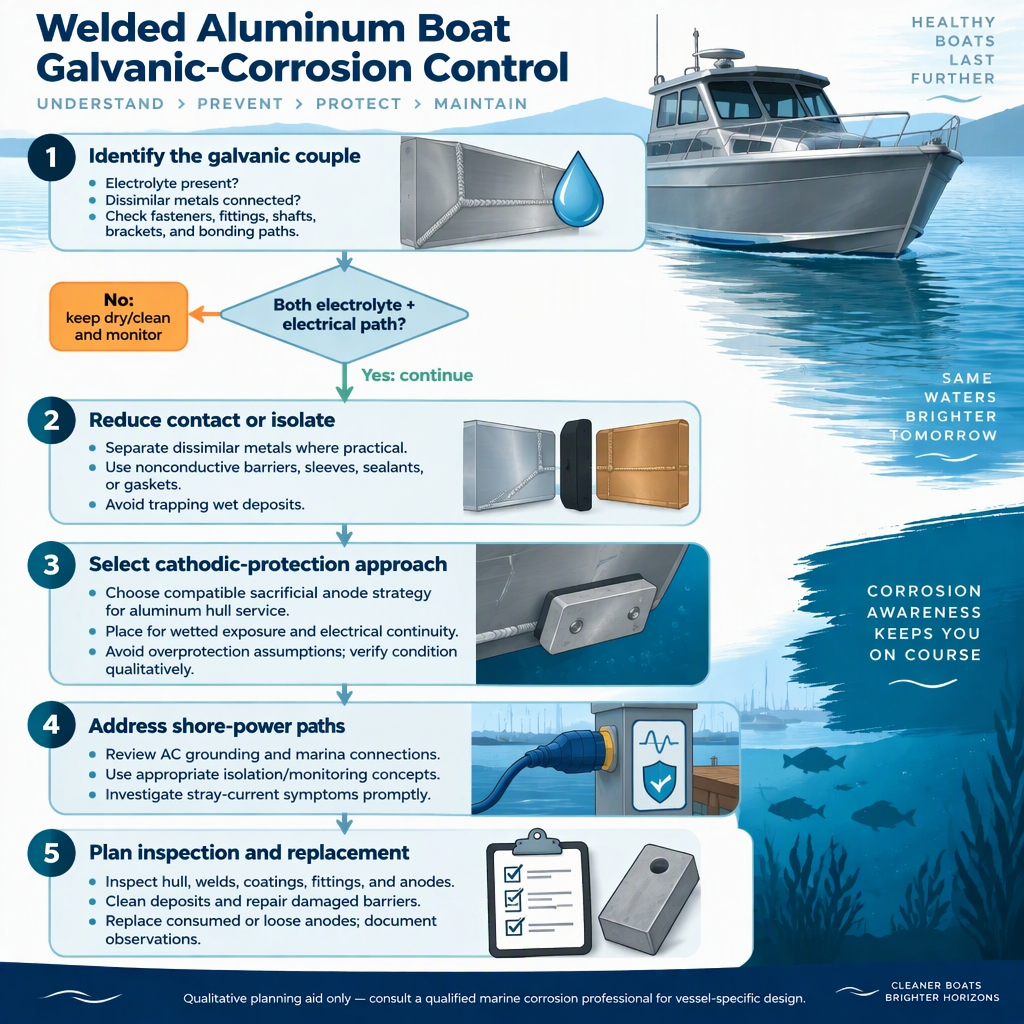
| Element | What to specify | What not to assume |
|---|---|---|
| Sacrificial anodes | Ask which anode material is intended for the expected water type and how inspection or replacement access will be handled. | Do not assume generic anode placement or mass is correct without project-specific cathodic-protection design input. |
| Metal isolation | Ask how stainless, bronze, coated steel, and other non-aluminum components will be isolated from the aluminum structure where practical. | Do not assume that a small contact area is harmless if it creates an unfavorable galvanic area relationship. |
| Shore-power protection | For boats connected to dockside power, discuss galvanic isolators, isolation transformers, and marina electrical conditions with qualified electrical specialists. | Do not treat anodes as the only defense when dockside electrical paths may contribute to corrosion risk. |
| Coating continuity | Ask how coating damage around fittings, bilge areas, and underwater appendages will be prevented, inspected, and repaired. | Do not rely on coatings alone if dissimilar metals remain electrically connected in wet service. |
For any manual inspection, cleaning, or replacement around powered equipment, switch off and disconnect the relevant shore power, battery, or other energy source before manual access, then follow the model manual and qualified-service procedures.
Standards and design data to confirm before the RFQ
Before the RFQ, ask which cathodic-protection reference, class rule, local requirement, and project design data will govern the corrosion-control package.
DNV-RP-B401 Cathodic protection design is identified by DNV as a recommended practice, edition 2021-05, for cathodic-protection design using aluminium or zinc based galvanic anodes and for specification of manufacture and installation of such anodes.
Use that type of reference as a prompt for a professional design conversation, not as a substitute for project engineering, current class requirements, flag-state rules, owner requirements, or local authority review.
- Ask the designer which cathodic-protection design reference will be used and whether it applies to the boat’s materials, water exposure, coating condition, and operating profile.
- Provide a list of all underwater and wet-area metals so the galvanic relationships can be reviewed before construction or outfitting.
- State whether the boat will operate in saltwater, brackish water, freshwater, or alternating environments, because marine anode practice depends on water conditions.
- Describe shore-power connection patterns, charging arrangements, and marina lay-up conditions so electrical isolation choices are not left until delivery.
- Ask for the anode inspection and replacement approach, but leave exact sizing and placement to the responsible designer or qualified corrosion specialist.
RFQ checklist for corrosion-conscious welded aluminum boat procurement
A good RFQ should make the corrosive environment, metal interfaces, electrical conditions, and maintenance responsibilities visible before price comparison begins.
- Define the application: patrol, workboat, passenger transfer, fishing support, landing craft, or other duty, because load, stability, fittings, and deck equipment influence wet metal interfaces.
- State the operating waters and lay-up waters separately if the boat moves between saltwater, brackish water, and freshwater.
- Request a list of major dissimilar-metal contacts, including underwater hardware, deck fittings exposed to seawater, fastening systems, and electrical bonding points.
- Ask how anodes will be selected, installed, inspected, and replaced for the expected service environment.
- Identify whether shore power, battery charging, or marina storage will be routine, then ask how galvanic isolation or isolation-transformer choices will be handled.
- Ask which standards, class requirements, or recommended practices will guide cathodic-protection design, and request the current edition or project basis from the responsible party.
- Request coating and isolation details for penetrations, brackets, appendages, and areas where coating damage is likely during service.
- Ask for an operator inspection plan covering anode condition, coating damage, unusual corrosion, shore-power accessories, and corrective-action triggers.
Use the checklist above as the technical basis for supplier discussions: compare proposals by how clearly they address the corrosion path, not only by hull material or headline construction method.
Inspection and maintenance limits after delivery
After delivery, operators should inspect anodes, coatings, dissimilar-metal interfaces, and shore-power arrangements regularly enough for the boat’s actual water and duty cycle.
- Start each inspection plan with the water type and storage pattern, because anode behavior and corrosion exposure differ between saltwater, brackish water, freshwater, and dockside lay-up.
- Before manual access to powered equipment, chargers, shore-power gear, pumps, or battery-connected areas, switch off and disconnect the relevant power source, then follow the official manual and qualified-service instructions.
- Check sacrificial anodes for consumption, secure attachment, paint coverage mistakes, and replacement access.
- Look for corrosion around dissimilar-metal contacts, especially where coating damage or trapped moisture creates an electrolyte path.
- Review shore-power accessories and dockside electrical conditions with qualified marine electrical personnel when corrosion appears abnormal or rapid.
- Record findings by location so repeated attack near the same fitting, bracket, or appendage can be treated as a design or isolation issue rather than only a cleaning task.
Do not turn general guidance into fixed anode mass, inspection interval, hull-potential target, or coating specification without project engineering and the applicable standard, class, and local requirements.
Conclusion
The buyer’s decision is whether the proposed boat package makes corrosion pathways visible and manageable before construction, delivery, and operation.
- Galvanic corrosion control begins with the metal pairings, electrolyte exposure, and electrical path.
- Anodes, water type, shore power, and inspection access belong in the same procurement discussion.
- Standards and recommended practices should guide qualified design work, but project-specific inputs still matter.
- For welded aluminum boat corrosion control, the RFQ should ask for corrosion-management details instead of relying on material choice alone.
Before selecting a welded aluminum boat, align the intended use, load, stability needs, materials, sea conditions, electrical arrangements, regulatory or class context, and maintenance responsibilities with the corrosion-control plan.
FAQs about welded aluminum boat corrosion
Most buyer questions come back to the same principle: control the electrical couple, the wet environment, and the maintenance plan together.
Is a welded aluminum boat immune to galvanic corrosion?
No. Aluminum can be part of a galvanic couple when it is electrically connected to dissimilar materials in a conductive electrolyte.
Why does water type matter for welded aluminum boat corrosion?
Marine corrosion guidance treats water type as a practical factor because saltwater, brackish water, and freshwater can call for different anode and inspection decisions.
Are sacrificial anodes enough by themselves?
No. Anodes are only one part of the corrosion-control system; buyers should also review metal isolation, coating condition, shore-power exposure, and inspection access.
Should shore power be discussed before ordering the boat?
Yes. If the boat will connect to dockside power or charging systems, discuss galvanic isolation, isolation transformers, and qualified electrical review before the build details are finalized.
Which standard should a buyer ask about?
Ask the designer or yard which current cathodic-protection reference, class requirement, or owner specification applies; DNV identifies DNV-RP-B401, edition 2021-05, as a recommended practice for galvanic-anode cathodic-protection design.
Can an RFQ specify the exact anode size?
An RFQ can request the anode design basis, inspection access, and replacement approach, but exact anode sizing should come from qualified project design rather than a generic purchasing checklist.
What should operators watch after delivery?
Operators should watch for repeated attack near dissimilar-metal contacts, damaged coatings, consumed or painted-over anodes, and any change that creates a new wet electrical path.


