


Before a boat fuel tank installation is signed off, four things decide whether the tank goes in: the rule set that actually covers your hull, the tank label and the test statement behind it, the mounting limits that stop the tank becoming structure, and the opening and vent geometry that keeps fuel where it belongs. Work through them in that order, record what you found, and only then connect hoses.
Which boats does a pre-installation fuel tank check apply to?
In the United States, the federal fuel-system rules for recreational boats sit in 33 CFR Part 183 Subpart J, and that subpart applies to boats with gasoline engines used for electrical generation, mechanical power or propulsion — but not to outboard engines. A built-in gasoline tank on an inboard or sterndrive boat falls inside it; a portable tank feeding an outboard does not.
The Coast Guard's list of federal regulations for recreational boats maps fuel systems to 33 CFR 183.501–590 and ventilation to 33 CFR 183.601–630, which confirms you are reading the right subpart before you start.
Diesel installations, outboard and portable tanks, and vessels outside the United States are not covered by the subpart described here. For those, ask the tank supplier for the documents your market requires and confirm with the authority that governs your vessel which regime applies to your hull, engine type and trade area.
What should the tank's label and test record show before installation?
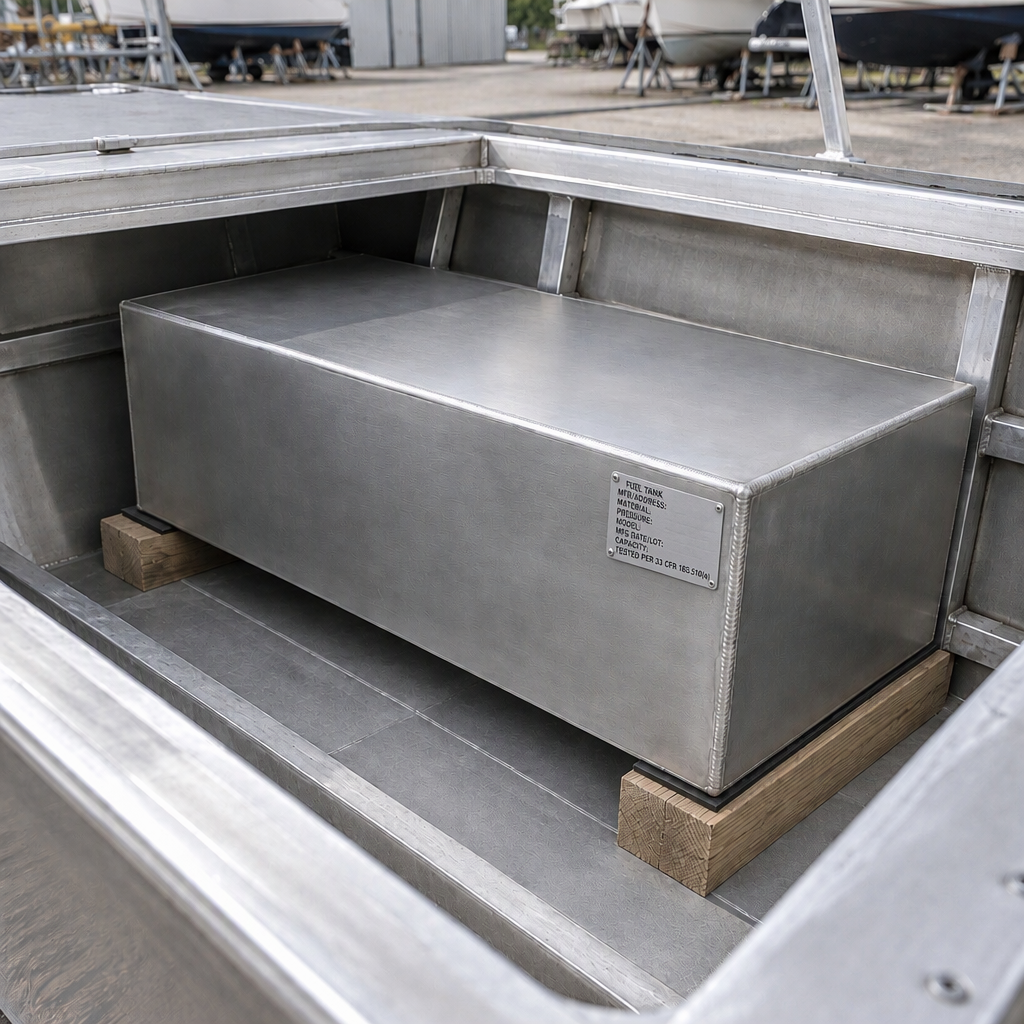
The label is the tank's documentation. Before installation it should state the manufacturer's name or logo and address, the month or lot number and year of manufacture, capacity in US gallons, the material of construction, the pressure the tank is designed to withstand without leaking, the model number where one applies, and the statement that the tank has been tested under 33 CFR 183.510(a). Where the tank was tested at less than 25 g vertical acceleration, the label must also carry the aft-of-half-length installation statement.
- Manufacturer name or logo, together with an address.
- Month or lot number and year of manufacture.
- Capacity in US gallons.
- Material of construction.
- The pressure the tank is designed to withstand without leaking — this is the figure the vent system is later measured against.
- Model number, where one applies.
- The statement that the tank has been tested under 33 CFR 183.510(a).
- Where the tank was tested at less than 25 g vertical acceleration, the aft-of-half-length installation statement.
A label statement that the tank was tested under 33 CFR 183.510(a) means the maker tested it under 183.580 and that it does not leak at the pressure marked on the label. The same section requires the tank to pass the fire test in 183.590 and the static pressure test for its capacity band: under 25 gallons, 25 to 199 gallons, or 200 gallons and over. That is a statement about the tank, not an approval of your installation.
The label requirements at 33 CFR 183.514 list every item a delivered tank should carry, so the label can be checked line by line before the tank is set in place.
How must the tank be supported, secured and isolated in the hull?
The tank is a supported component, not part of the structure. It must not be integral with boat structure and must not be mounted on the engine, it must not move more than one quarter inch in any direction at the mounting surface, and it must not carry a deck, bulkhead or other structural component. The installation rules at 33 CFR 183.550 set those limits together with the drainage and insulation conditions.
| Check | What the installation must satisfy |
|---|---|
| Relationship to hull structure | The tank is not integral with boat structure. |
| Mounting on the engine | The tank is not mounted on an engine. |
| Movement at the mounting surface | No more than one quarter inch in any direction. |
| Structural duty | No deck, bulkhead or other structural component is supported by the tank. |
| Water drainage on a metallic tank | Water drains from the top surface when the boat is in its static floating position. |
| Supports, chocks and straps on a metallic tank | Insulated from the tank with non-moisture-absorbing material. |
| Cellular plastic | Not used as the sole support of a metallic tank. |
Foam is not a way around those limits. Where cellular plastic encases a metallic tank, the material has to hold its volume within five percent and not dissolve after 24 hours immersed at 29 °C in reference fuel B, No. 2 reference oil and a five percent trisodium phosphate solution; it must absorb no more than 0.12 pound of water per square foot of cut surface; and if it is polyurethane it needs a density of at least 2.0 pounds per cubic foot, while non-polyurethane foam must reach at least 60 psi compressive strength at ten percent deflection.
Where must fill, supply and vent openings sit, and what must the vent system do?
Every opening into the fuel tank — fill, supply, return or gauge — must be at or above the topmost surface of the tank. That top surface is the datum: nothing that can leak should sit below the fuel level the tank holds.
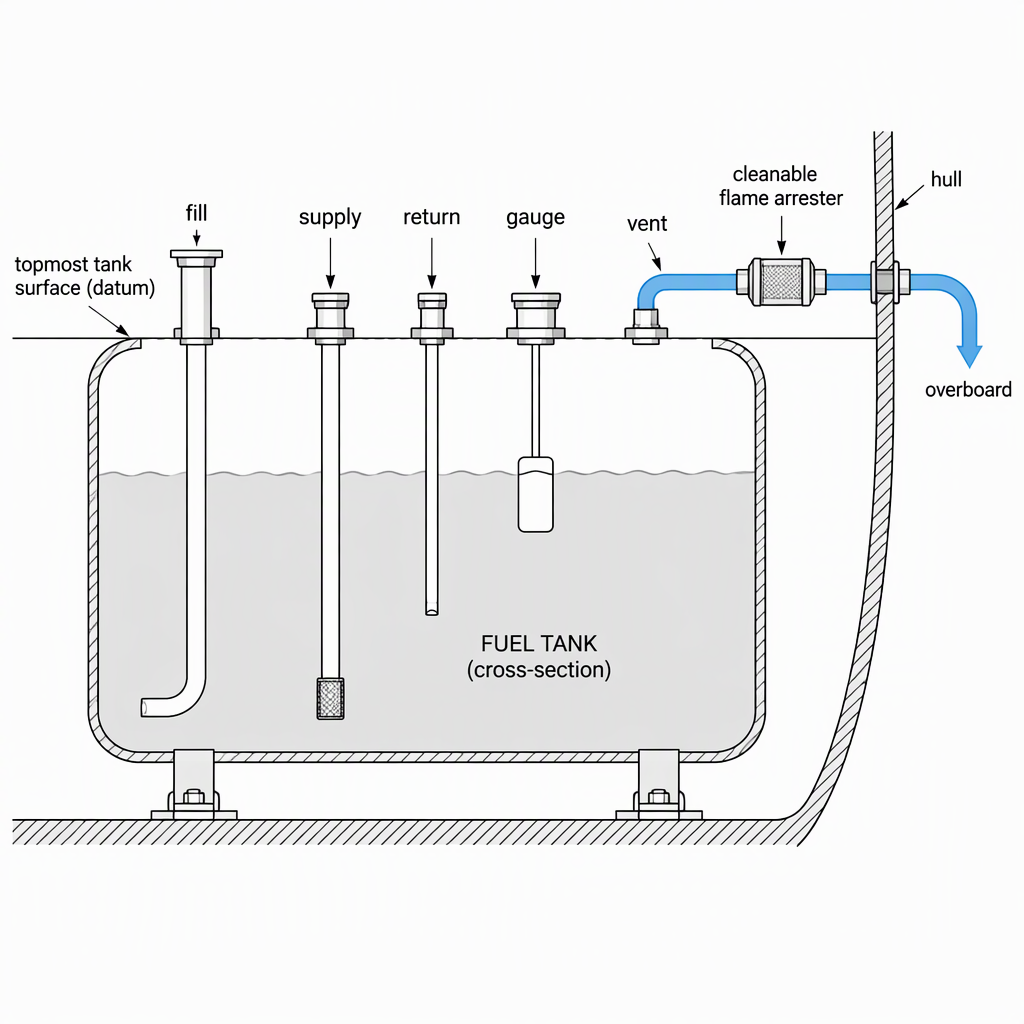
- Establish the tank's topmost surface in its installed static floating position and treat it as the reference line.
- Check every opening — fill, supply, return, gauge — against that line.
- Route the vent so tank pressure cannot exceed 80 percent of the pressure marked on the tank label.
- Fit a cleanable flame arrester at the vent unless the vent itself is a flame arrester, and leave enough access to clean it.
- Confirm the vent will not let an overflow of up to two gallons per minute enter the boat — route the discharge overboard, not into a locker or the bilge.
A vent that discharges inside a closed compartment turns a routine fill into a hazard. The vent system requirements at 33 CFR 183.520 cover the overpressure limit, the flame arrester and the overflow condition, so plan the discharge route with the same care as the fill line and keep the arrester reachable.
Which hose, fitting and plug details should be verified before connection?
A hose's type can only be established from the permanent marking on the hose itself, so read the USCG type, SAE class, marking text and year of manufacture on each length before it is connected. The USCG Type A1, A2, B1 and B2 designations are defined by SAE J1527DEC85 Class 1 or Class 2 performance, with the A types additionally required to pass the 183.590 fire test, and UL 1114 accepted as an alternative basis for A1. Class 1 hose permits 100 g or less of fuel loss per square metre of interior surface in 24 hours; Class 2 permits 300 g or less. The hose standards and markings at 33 CFR 183.540 are the reference to check deliveries against.
| USCG type | SAE J1527DEC85 class | 183.590 fire test | Permeation rating |
|---|---|---|---|
| A1 | Class 1 | Required; UL 1114 accepted as an alternative basis for A1 | 100 g or less |
| A2 | Class 2 | Required | 300 g or less |
| B1 | Class 1 | Not part of the B designation | 100 g or less |
| B2 | Class 2 | Not part of the B designation | 300 g or less |
Hose must carry permanent English marking of its type, year of manufacture and the maker's name or trademark, in block capitals at least one eighth of an inch high and repeated at intervals of 12 inches or less. A hose whose marking you cannot read is a hose you cannot assign to a type.
Two fitting details are easy to miss: the fuel system must not have a fitting for draining fuel, and a plug used to service the fuel filter or strainer must have a tapered pipe thread, or be a screw type fitted with a locking device other than a split lock washer.
Before making or breaking any fuel connection, or opening the vent for cleaning, isolate the boat's electrical supply — switch off and disconnect the battery — and keep flames, sparks, hot surfaces and running engines out of the compartment.
Who owns which check, and what should be recorded before the system is filled?
The tank maker owns the label and the tests behind it; the boat builder or installer owns the mounting, opening and venting conditions; the operator, dealer or surveyor owns the release check and the record. Because the label evidence and the installation evidence come from different parties, the handover record is what lets a later service, survey or resale verify the same conditions again.
- An uncropped photograph or copy of the tank label showing capacity, material, marked pressure, model number and the test statement.
- The label's aft-of-half-length statement, where it carries one, and confirmation that the tank's centre of gravity sits aft of the boat's half length.
- The mounting record: what the tank rests on, what insulates a metallic tank from its supports, chocks and straps, and how the one-quarter-inch movement limit was confirmed.
- Confirmation that the tank supports no structural component and is not mounted on the engine.
- The opening record: the datum used and the position of each opening relative to it.
- The vent record: where the flame arrester sits, how it is cleaned, and where an overflow discharges.
- The hose record: USCG type, SAE class, the marking observed and the year of manufacture read from the hose.
- If cellular plastic encases the tank, the material's properties and confirmation that it is not the sole support.
- Confirm which subpart or regime governs your hull, engine type and market before you start.
- Check the label against the required items and keep a copy of it with the boat.
- Verify movement, drainage, insulation and vent geometry, and record the conditions you accepted.
- Verify hose type from the marking on the hose, not from the reel label or the invoice.
What to confirm before the tank is installed
Release the installation only when the label is complete and its test statement is present, the tank cannot move more than one quarter inch at its mounting surface and carries no structure, every opening sits at or above the topmost tank surface, the vent protects against overpressure and discharges any overflow overboard, and every hose can be identified from its own marking.
Those conditions, written down and confirmed by the parties who checked them, are what a later survey, resale or warranty conversation rests on. Anything you cannot tie back to a document or to a marked part is worth holding before the system is filled.
Frequently asked questions
The questions below cover the checks that most often stall a release: what a tank label actually proves, where the aft-of-half-length condition applies, which installations fall outside the subpart, and what to do with a hose that carries no readable marking.
What does the label statement about being tested under 33 CFR 183.510(a) actually prove?
It shows the maker tested the tank under 183.580 and that it does not leak at the pressure marked on the label. The same section requires the fire test in 183.590 and the static pressure test for the tank's capacity band — under 25 gallons, 25 to 199 gallons, or 200 gallons and over. It is a statement about the tank, not about the installation.
When does the tank have to be installed aft of the boat's half length?
When the label carries the aft-of-half-length statement that 33 CFR 183.514 requires for a tank tested at less than 25 g vertical acceleration. In that case 33 CFR 183.550 requires the tank's centre of gravity to sit aft of the boat's half length. If the label carries no such statement, that particular condition does not apply — the movement, drainage and insulation limits still do.
Do these checks also cover a portable tank feeding an outboard engine?
No. The subpart applies to boats with gasoline engines other than outboard engines, so an outboard-fed portable tank sits outside it. Check the markings on the tank and hose you actually have, and ask your supplier or the authority that governs your vessel which requirements apply to that arrangement.
Do I need to check anything on the engine side of the fuel line, such as the carburettor?
Yes, as a separate item. 33 CFR 183.526 limits a carburettor to no more than five cubic centimetres of fuel leakage in 30 seconds under the stated float-valve, half-throttle, cranking and maximum fuel-pump-pressure conditions, and requires updraft and horizontal draft carburettors to have a device that collects fuel, prevents it being carried out by backfire shock or reverse air flow, and returns it to the induction system after start.
Can the tank simply be foamed into place?
Not as a substitute for support. Cellular plastic may not be the sole support of a metallic tank, and where it encases one it must also meet the material properties in 33 CFR 183.516, including volume stability and water-absorption limits. Foam can help hold a tank in position; it cannot be the only thing holding it.
What do I do if the hose in stock carries no USCG type marking?
You cannot show it is a USCG type. 33 CFR 183.540 requires permanent English marking of type, year of manufacture and the maker's name or trademark, in block capitals at least one eighth of an inch high and repeated at intervals of 12 inches or less. Keep unmarked hose out of a fuel system you are releasing, and order hose whose marking you can read.
Will these checks satisfy CE, ISO or another national regime outside the United States?
They address the US federal subpart only. Outside the United States — and for diesel, outboard and portable installations anywhere — your flag state's rules, a classification society's requirements or a regional conformity scheme will apply instead. Ask the tank supplier for the documents your market requires, and confirm applicability with the authority that governs your vessel.


