


For boat flotation requirements, start by matching the project jurisdiction and boat type before discussing foam, air chambers, or supplier quotes. In U.S. federal guidance, flotation is organized across separate rule areas including Subpart F, Subpart G, and Subpart H, and the U.S. Coast Guard handbook page is guidance for federal regulations rather than a complete engineering manual.
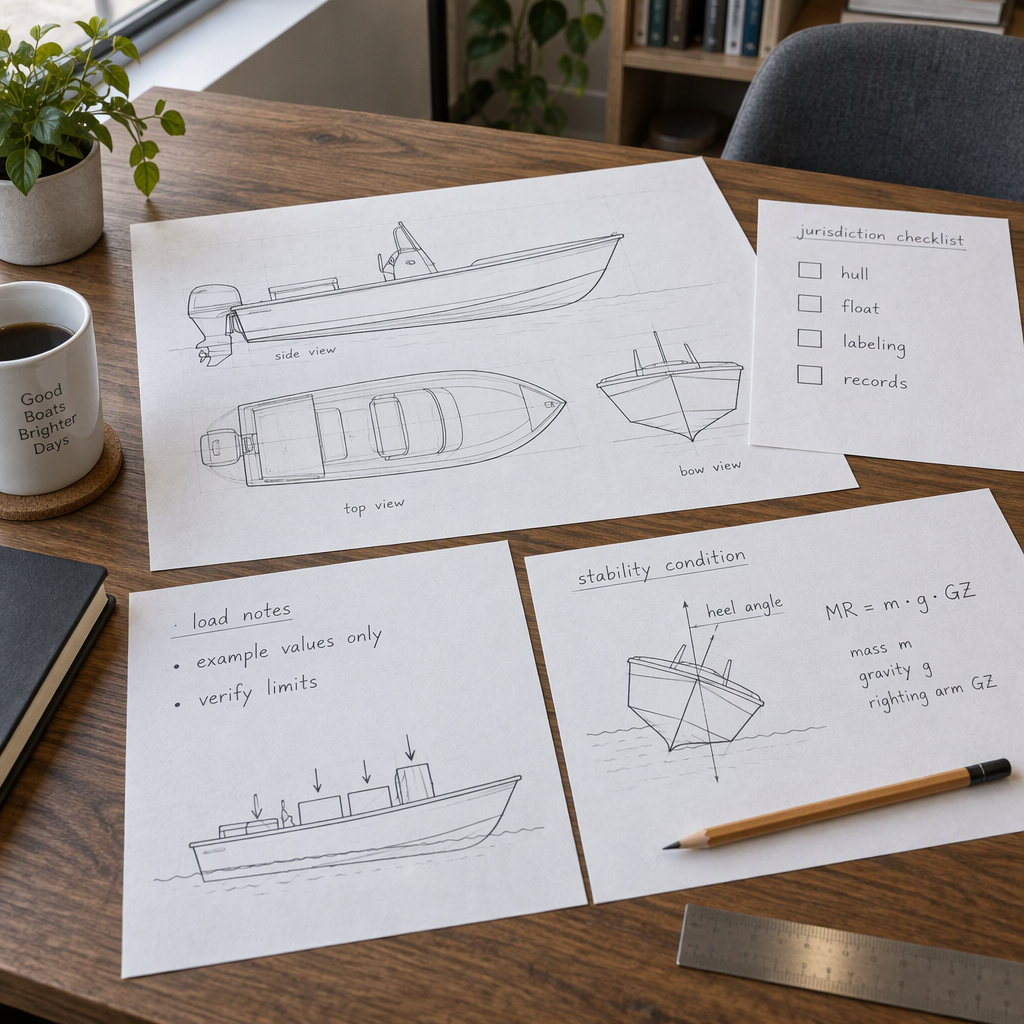
Check the jurisdiction before checking the boat
The first check is where the boat will be sold, registered, operated, or accepted, because a flotation discussion based on one rule family may not answer another market’s compliance question.
For U.S. recreational boat manufacturing context, the U.S. Coast Guard Boatbuilder’s Handbook flotation page separates flotation compliance guidance into Subpart F, Subpart G, and Subpart H topics covering 33 CFR sections 183.101 through 183.335, while also warning that the guide addresses federal regulations only and is not a complete engineering manual.
For ISO-based small craft stability assessment, Transport Canada explains that the standard relates resistance to taking on water to minimum requirements for operating conditions, so market, operating category, and acceptance authority should be clarified before procurement language is finalized.
Match the rule family to the boat type
Boat type matters because U.S. Subpart F is described for a defined group of monohull inboard boats, inboard/outdrive boats, and airboats less than 20 feet in length, with named exclusions.
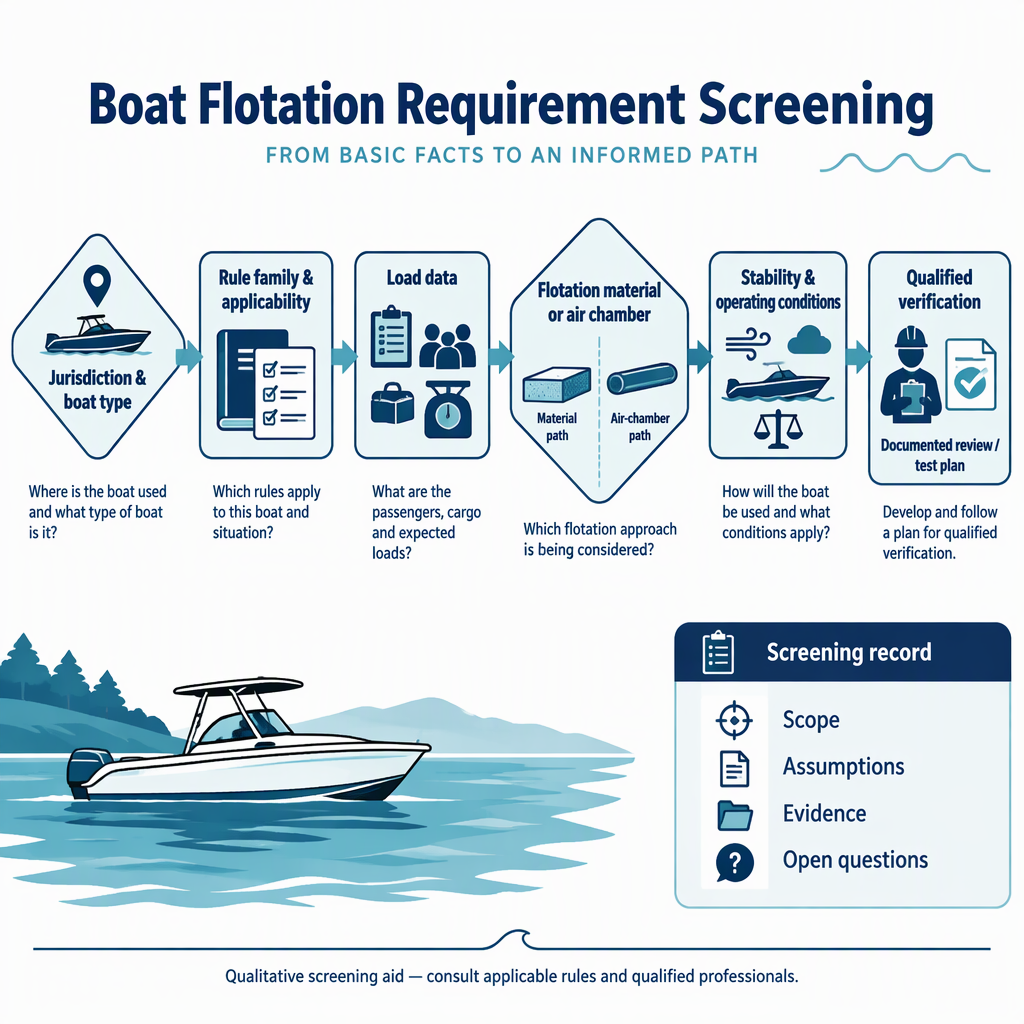
| Buyer check | Why it changes the flotation path | What to prepare |
|---|---|---|
| Jurisdiction and rule family | The U.S. Coast Guard guidance page separates flotation guidance into different subparts rather than one universal rule for all boats. | Target market, registration or sale location, and acceptance authority. |
| Hull, propulsion, and length | 33 CFR § 183.101 describes Subpart F applicability for monohull inboard, inboard/outdrive, and airboats less than 20 feet. | Hull form, propulsion arrangement, and measured length basis. |
| Named exclusions | The same applicability section lists exclusions such as sailboats, canoes, kayaks, inflatable boats, submersibles, surface effect vessels, amphibious vessels, and raceboats. | Intended use statement and evidence that the selected category is correct. |
| Operating conditions | ISO-based stability guidance uses design categories connected to wave height and wind force. | Expected service area, sea state, loading cases, and exposure assumptions. |
Know the Subpart F boundary before applying it
Do not treat 33 CFR Subpart F as a universal small-boat flotation rule; first confirm whether the boat sits inside its stated applicability boundary.
33 CFR § 183.101 states that Subpart F applies to monohull inboard boats, inboard/outdrive boats, and airboats less than 20 feet in length, and it also states exclusions including sailboats, canoes, kayaks, inflatable boats, submersibles, surface effect vessels, amphibious vessels, and raceboats.
If the project is outside that boundary, the practical next step is not to force Subpart F language into the RFQ. Ask the designer, builder, or compliance specialist to identify the applicable rule family for the boat type and market.
Confirm the load data before discussing flotation quantity
A flotation quantity discussion needs load assumptions first, because 33 CFR § 183.105 frames flotation around keeping some portion of a covered boat above the water surface after submersion in calm fresh water for at least 18 hours under specified loading assumptions.
- Ask which loading assumptions are being used for the flotation check, including the section-specific dead weight concept in 33 CFR § 183.105.
- Prepare the intended persons capacity, maximum weight capacity, propulsion arrangement, and major fixed equipment list before requesting an engineering review.
- Separate normal operating load from compliance-test assumptions; the buyer’s payload scenario and the rule’s test assumptions may not be the same thing.
- Give the designer the intended use case, because passenger operations, dealer demonstration use, private recreation, and workboat-style duty can lead to different documentation expectations.
Review flotation material and air-chamber choices
The flotation method is not only a volume question; buyers should ask where material is located and whether any air-chamber concept is permitted for the applicable rule path.
| Flotation approach question | What the buyer should ask | Regulatory planning point |
|---|---|---|
| Foam or other flotation material near machinery spaces | Where will flotation material be installed relative to the engine room, engine-room bilge, or bilge? | 33 CFR § 183.112 states that flotation materials in engine-room bilge, engine room, or bilge locations must meet § 183.114 requirements unless in a sealed compartment. |
| Sealed compartment strategy | Which compartments are sealed, how are they documented, and how are penetrations controlled? | The same section creates a distinction for material in a sealed compartment. |
| Air chambers | Are air chambers being proposed to meet flotation requirements, and how are they arranged? | 33 CFR § 183.112 states that air chambers used to meet Subpart F flotation requirements must not be integral with the hull. |
Connect flotation with stability and operating conditions
Flotation checks should be connected with stability, downflooding, and operating-condition assumptions, because buoyancy after swamping is only one part of small craft safety assessment.
- Define the operating condition category. Transport Canada’s ISO 12217-1 guidance explains that design categories are based on wave height and wind force.
- Identify resistance to taking on water. Transport Canada describes ISO 12217-1 stability assessment as relating resistance to taking on water to minimum requirements for operating conditions.
- Map downflooding paths, deck openings, hatches, drains, and loading conditions into the design review instead of asking for flotation material in isolation.
- Confirm the exact standard edition and project acceptance basis with the authority, designer, or certification body before freezing drawings or procurement documents.
Transport Canada also cautions that compliance with a stability standard does not guarantee total safety or freedom from capsize or sinking, so procurement language should avoid treating a single stability or flotation reference as an absolute safety guarantee.
Understand the limits of a checklist
A checklist can organize the conversation, but it cannot replace the current rule text, a qualified engineering assessment, or project-specific compliance review.
The U.S. Coast Guard handbook page itself frames the material as federal regulatory guidance rather than a complete engineering manual.
Transport Canada’s ISO stability guidance also explains that meeting a stability standard is not a guarantee against capsize or sinking.
Escalate beyond a generic checklist when the boat is close to a length threshold, combines unusual propulsion and hull features, carries changing passenger or equipment loads, will be sold across multiple jurisdictions, or depends on sealed compartments or air chambers for the flotation strategy.
Prepare the RFQ data package
A useful RFQ package should let a builder or designer classify the boat, identify the applicable flotation and stability path, and request the right supporting documents before pricing or design approval.
- State hull type, propulsion type, and length, because Subpart F applicability depends on these features for the U.S. rule path described in 33 CFR § 183.101.
- State whether any named exclusion may apply, such as sailboat, canoe, kayak, inflatable boat, submersible, surface effect vessel, amphibious vessel, or raceboat.
- Provide capacity and load information needed to discuss flotation quantity under the loading assumptions referenced in 33 CFR § 183.105.
- Ask the supplier to identify the proposed flotation material locations, sealed compartments, and any air-chamber approach.
- Include intended operating area, wave and wind assumptions, downflooding concerns, and stability documentation expectations.
- Request the current applicable rule references, drawings, calculation basis, and inspection or test documentation from a qualified designer or compliance specialist.
Use this data package as the buyer-side brief for your boat designer, builder, or compliance reviewer before requesting a final quotation.
Conclusion
The safest buying sequence is to classify the boat and market first, then verify loads, flotation method, and stability assumptions with the responsible designer or authority.
For operators, dealers, designers, and procurement teams, boat flotation requirements are a selection problem as much as a regulatory topic. The RFQ should show the intended jurisdiction, boat category, length, load case, material approach, air-chamber assumptions, sea state, and stability expectations before a supplier is asked to commit to a design path.
- Subpart F has a defined boat-type boundary and exclusions.
- Flotation quantity checks depend on stated loading assumptions.
- Material location and air-chamber design can affect the compliance path.
- Stability and operating conditions should be reviewed alongside flotation.
FAQs About Boat Flotation Requirements
These questions help buyers turn a general flotation topic into a project-specific design and procurement check.
Do boat flotation requirements apply the same way in every country?
No. The U.S. Coast Guard guidance page addresses U.S. federal flotation regulations, so buyers should confirm the current requirements for the country where the boat will be sold, registered, or accepted.
Does 33 CFR Subpart F apply to every small boat?
No. 33 CFR § 183.101 describes Subpart F for monohull inboard boats, inboard/outdrive boats, and airboats less than 20 feet in length, and it lists several exclusions.
What data should be ready before asking about flotation quantity?
Prepare the boat type, length, propulsion arrangement, intended capacity, maximum weight assumptions, fixed equipment, and any dead-weight assumptions relevant to the selected rule path.
Can air chambers be used for Subpart F flotation?
Air chambers require careful review because 33 CFR § 183.112 states that air chambers used to meet Subpart F flotation requirements must not be integral with the hull.
How do sea state and stability affect flotation selection?
Transport Canada’s ISO 12217-1 guidance connects design categories with wave height and wind force, so intended operating conditions should be part of the stability and flotation review.
Can this article give definitive legal compliance advice for the U.S., EU, and every export market?
Use it as a buyer’s preparation checklist, not as legal advice. Confirm the current adopted rules, local amendments, and acceptance documents with the responsible authority, designer, or compliance specialist.
Which exact ISO 12217-1 edition is current for my project?
Confirm the exact ISO edition with the project authority or certification body. Transport Canada explains the role of ISO 12217-1 in small craft stability assessment, but the buyer should verify the edition and acceptance basis for the specific market.


