Views: 0 Author: Site Editor Publish Time: 2026-07-21 Origin: Site


Moving heavy equipment, personnel, and vital supplies to austere shores demands highly specialized maritime assets. Traditional transport vessels simply cannot reach these remote operational theaters safely. Modern logistics teams frequently encounter coastal environments lacking established port infrastructure or deep-water piers. You need a reliable, rugged vessel to overcome these geographic barriers. Bridging the gap between deep-water mother ships and shallow coastlines requires precise engineering and balanced design.
Modern utility ships balance massive payload capacity, shallow-draft maneuverability, and strict maritime compliance. You cannot compromise on any of these factors during coastal operations. This comprehensive guide gives procurement teams, defense contractors, and commercial logistics directors an objective, spec-driven framework. We will explore exactly how to evaluate and shortlist the best maritime assets for your specific mission profile.
You will discover practical methods to assess payload metrics and navigate complex regulatory classifications. We also break down how to evaluate shipbuilders effectively. Our goal is to ensure you procure a vessel matching your precise operational demands without facing unexpected regulatory hurdles.
Assessing landing craft viability requires calculating the exact ratio of deck load capacity (tons/sq ft) to maximum operational draft.
Military-spec (MIL-SPEC) and commercial classification (e.g., ABS, USCG) dictate baseline costs, build timelines, and operational legality.
Procurement shortlisting must heavily weight a shipyard’s historical delivery record, modular customization capabilities, and lifecycle sustainment support.
Logistics directors frequently face environments lacking established marine infrastructure. Deep-water piers often sustain severe damage during natural disasters. Many remote islands never had commercial port facilities to begin with. Standard logistics vessels fail completely under these austere conditions. Their deep V-shaped hulls cannot safely approach shallow gradients. They also rely entirely on shoreside cranes to unload heavy cargo.
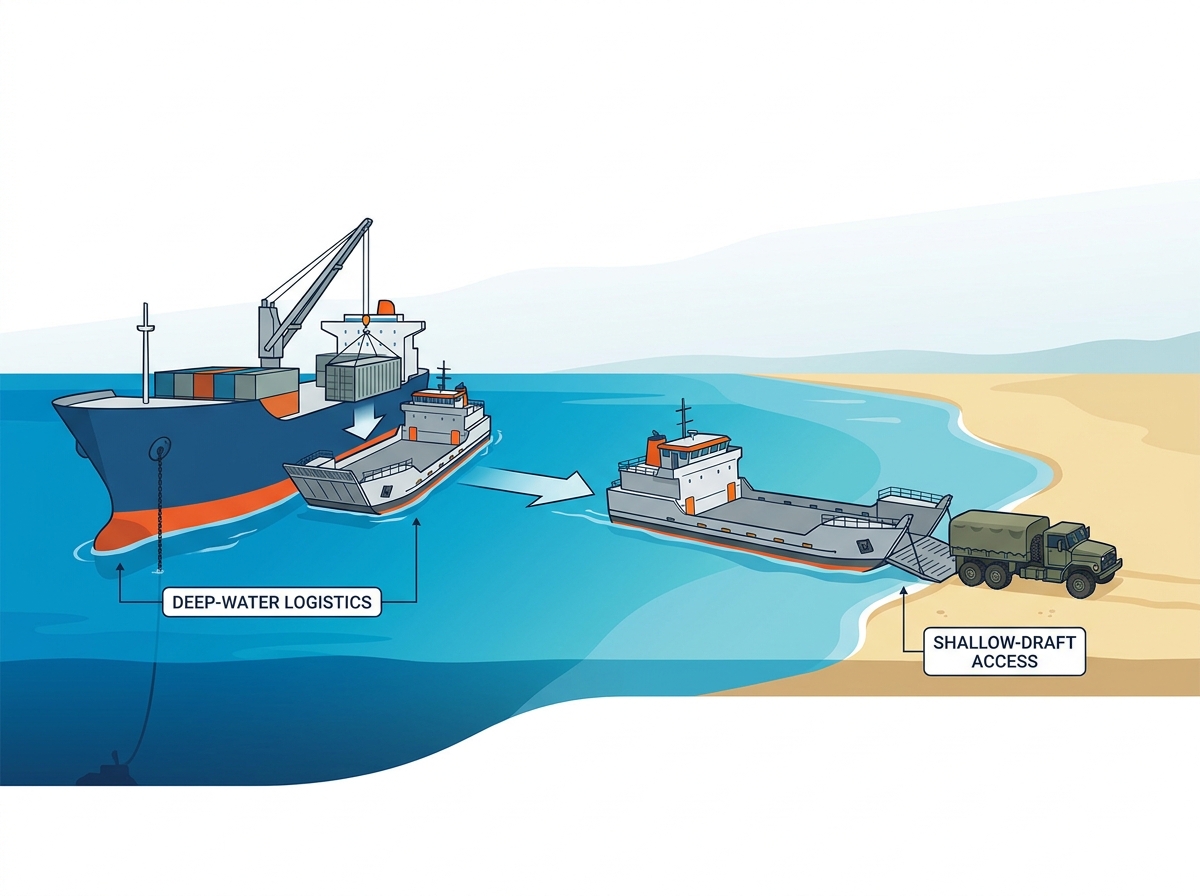
Deploying a standard Landing Craft solves these logistical bottlenecks directly. These specialized utility ships provide immediate Roll-On/Roll-Off (RO-RO) capabilities. They navigate shallow waters safely and beach directly onto riverbanks, sandbars, and disaster zones. You can drive heavy excavators or military vehicles straight from the cargo deck onto dry land.
We define a successful procurement by how well the vessel solves your specific logistical bottleneck. The ideal ship bridges the gap between deep-water mother ships and the shore seamlessly. It must achieve this without incurring unnecessary draft. It must also maintain adequate open-ocean seaworthiness for coastal transits.
To determine if you truly require this specific hull type, evaluate your mission against these success criteria:
Infrastructure Independence: You operate in regions where docks, cranes, and stevedores are entirely unavailable.
Direct Shore Access: Your cargo includes wheeled or tracked vehicles requiring direct RO-RO discharge onto natural terrain.
Draft Restrictions: Your operational theater features uncharted shallows, tidal flats, or river estuaries preventing conventional ship access.
Heavy Payload Needs: You must transport dense, heavy equipment rather than light personnel or simple bulk goods.
Evaluating deck load capacity requires precise structural analysis. You must match structural deck limits to your anticipated cargo. Engineers measure these limits in pounds per square foot (lbs/sq ft). M1 Abrams tanks and commercial excavators exert massive point loads on the deck plating. In contrast, standard ISO containers distribute their weight more evenly. Naval architects must specify thickened deck plates and heavy underlying framing to support tracked vehicles.
You must also calculate the critical draft trade-off. Maximizing cargo weight directly impacts the vessel’s operational draft. As you load more tonnage, the hull sinks deeper into the water. This increased draft restricts your access to specific shallow-water gradients. A fully loaded vessel might ground fifty yards from the beach, rendering its bow ramp useless. You must calculate exact margins to ensure your payload does not compromise your beaching capability.
Selecting the right propulsion configuration dictates your operational success. You must analyze conventional twin-screw setups, waterjets, and cycloidal propellers against your specific mission profiles. Each system offers distinct advantages in shallow environments.
Propulsion Configuration Comparison
System Type | Shallow Water Safety | Maneuverability | Debris Resistance |
|---|---|---|---|
Conventional Twin-Screw | Moderate (Exposed props) | Good | Poor |
Waterjets | Excellent (Flush hull) | Excellent | Moderate (Intake clogging) |
Cycloidal Propellers | Poor (Deep vertical blades) | Unmatched Precision | Poor |
You must also evaluate station-keeping capabilities. Coastal currents constantly push vessels sideways during beaching operations. Maneuvering bow thrusters become necessary for holding position. If the vessel drifts during RO-RO offloading, a tank or truck could slide off the ramp into the water. Strong station-keeping ensures the ramp remains perfectly aligned with the landing zone.
The bow ramp serves as the critical interface between ship and shore. You must assess ramp articulation, total width, and maximum weight ratings carefully. Hydraulic rams dictate how far the ramp can articulate downward. A steep ramp angle creates breakover issues for long-wheelbase vehicles. Proper engineering ensures the ramp extends far enough to provide a shallow, safe slope.
Beaching subjects the vessel to brutal physical forces. You must evaluate hull reinforcements rigorously. Naval architects design thickened keel plates to absorb impact. They also apply specialized abrasion-resistant coatings to the hull bottom. These features allow the vessel to withstand repeated grounding cycles on highly abrasive substrates like coral, gravel, and packed sand. Without these reinforcements, the hull will suffer severe structural degradation rapidly.
Procurement teams face a maze of regulatory frameworks. Understanding these rules ensures operational legality and safety.
Military vs. Commercial Builds
You must understand the structural differences between military and commercial vessels. Ships built to US Navy or Defense specifications undergo rigorous shock-hardening. Engineers design the LCU 1700-class to survive nearby combat detonations. These builds feature highly redundant systems and complex damage control layouts. Commercial heavy-lift variants prioritize cost-efficiency and cargo volume instead. They skip combat-grade hardening to reduce weight and complexity.
Regulatory Frameworks
Commercial builds must adhere to strict civilian regulatory frameworks. Procurement teams factor in American Bureau of Shipping (ABS) rules during the design phase. You also need to align the build with United States Coast Guard (USCG) classifications. Subchapter T covers small passenger limits. Subchapter I regulates standard cargo operations. Subchapter L dictates rules for offshore supply vessels. If you operate internationally, the vessel must meet International Maritime Organization (IMO) standards.
Failing to specify the correct class at the beginning leads to massive redesign fees later.
The Jones Act
Domestic coastal trade inside the United States triggers Jones Act compliance. This century-old legislation requires vessels to be U.S.-built, U.S.-owned, and U.S.-crewed. You cannot buy a cheaper foreign-built hull and use it for commercial transport between two American ports. This law directly impacts your shipyard selection process. It forces domestic operators to partner exclusively with American shipbuilders, significantly altering project budgets and lead times.
Bringing a new utility ship into your fleet introduces specific operational realities. You must plan for aggressive maintenance and intensive crew training.
Maintenance Schedules
Beaching a steel or aluminum hull destroys standard marine coatings quickly. You must factor in frequent dry-docking cycles. Crews must reapply heavy-duty bottom painting much more often than on traditional deep-water ships. You also need a strict schedule for sacrificial anode replacement. Grounding exposes bare metal, accelerating galvanic corrosion in saltwater. Managing these maintenance schedules prevents premature hull failure and extends the operational life of your asset.
Crew Adoption and Training
Operating these specialized ships demands unique seamanship skills. Standard mariners rarely practice driving a heavy ship deliberately onto a beach. Crews must learn to navigate varied surf conditions safely. They need specific training to deploy stern anchors before grounding. Retracting a heavily loaded vessel from a mudbank requires coordinated winch and engine maneuvers. You must invest heavily in crew adoption programs to prevent accidents during these high-risk operations.
Risk Mitigation
Operating in remote zones means you cannot rely on quick supply chains. You must avoid proprietary, single-source propulsion systems. If a custom hydraulic component fails on an isolated beach, your vessel becomes stranded. Specify Commercial Off-The-Shelf (COTS) parts whenever possible. Standardized pumps, hoses, and engine filters simplify remote-area repairs. This risk mitigation strategy ensures your mechanics can source replacement parts locally, minimizing costly operational downtime.
Selecting the right shipyard determines the success of your entire procurement program. Do not rely solely on glossy brochures or theoretical naval architecture.
Historical Track Record
You must demand demonstrable past performance. Ask vendors to show you identical hull forms they have already delivered. A shipyard might boast massive theoretical capacity, but building a successful utility ship requires specific niche experience. Proven hull designs eliminate experimental risks. When shipyards use previously validated plans, they guarantee stability and payload metrics from day one.
Design Flexibility
While proven hulls reduce risk, your specific mission requires some customization. Assess a vendor's ability to modify baseline designs efficiently. Can they extend the cargo deck length? Can they upgrade crew quarters for extended missions? The best shipbuilders implement these changes using modular engineering. They adjust the baseline without requiring a complete, costly naval architecture overhaul.
Sustainment Packages
Your relationship with the manufacturer extends decades beyond delivery. Evaluate their post-delivery sustainment support strictly. You should review warranty terms for heavy-duty components like bow ramp hydraulics. Confirm their spare parts availability guarantees. Check if the yard offers mid-life refit capabilities. A strong sustainment package keeps your vessel operational through decades of brutal coastal deployments.
Next Steps
Once you narrow down your vendor list, establish a formal Request for Information (RFI). Your RFI must mandate verifiable load data and classification history. Demand realistic delivery timelines based on their current steel-cutting backlog. This structured approach forces vendors to provide objective engineering data rather than mere sales pitches.
Procuring a specialized utility ship remains a high-stakes balancing act. You must constantly weigh payload demands against draft limitations and strict regulatory compliance. Standard vessels simply cannot replicate the direct shore access and heavy lift capabilities of these unique maritime assets.
The most effective hull is always the one accurately matched to your specific beaching environment. A ship overbuilt for commercial cargo wastes fuel, while an underbuilt vessel risks structural failure on abrasive beaches. Understanding your regulatory framework ensures your asset remains legally operational across its entire lifespan.
We encourage buyers to take immediate action. Draft a finalized statement of operational requirements today. Use this technical document to initiate serious discussions with proven naval architects and shipyard engineering teams. Proper preparation guarantees you secure a vessel capable of mastering the world's most challenging coastal environments.
A: LCUs are generally larger vessels. They conduct sustained independent operations for several days. They feature integrated crew quarters and extensive galleys. LCMs act as smaller, short-range ship-to-shore shuttles. Crews use LCMs for quick transport rather than prolonged missions.
A: Crews deploy stern anchors, known as kedge anchors, before hitting the beach. Once offloading finishes, they engage reversed propulsion. Simultaneously, heavy-duty deck winches pull the vessel against the grounded stern anchors. This combined force breaks the hull's suction on the sand, pulling the ship safely back into deeper water.
A: Realistic timelines span 12 to 24 months. This duration depends heavily on shipyard backlogs and material availability. The process begins with finalized naval architecture and class approval. Afterward, shipbuilders cut steel, complete outfitting, and conduct rigorous sea trials before final delivery.
A: These vessels handle coastal transits well, but they face strict sea-state limitations. Naval architects optimize their flat-bottomed, shallow-draft designs for littoral zones. As a result, they experience significant rolling in deep-sea swells. Operators should limit open-ocean transits and focus on coastal or ship-to-shore mission profiles.


