Views: 0 Author: Site Editor Publish Time: 2026-07-06 Origin: Site


Let us set the record straight right away. We are focusing strictly on real-world, commercial, and heavy-duty recreational marine vessels. This guide does not cover virtual spaceships from video games. You have likely moved past off-the-shelf boats. Standard designs often fail when you face demanding shorelines. You require a purpose-built solution for remote access. Heavy payload transport demands highly specific shore-landing capabilities. Finding the exact right vessel is critical for safe and efficient operations. This guide provides a technical, transparent framework. We wrote it to help you evaluate custom options confidently. We will explore essential specifications, structural feature trade-offs, and procurement realities. You will learn exactly how to balance bow door mechanics, hull geometry, and material selection. Ultimately, this article equips you to make confident decisions when commissioning a custom build tailored entirely to your most demanding maritime tasks.
The Bow Door Dictates Utility: Choosing between manual winches and dual-hydraulic systems directly impacts payload types, loading speed, and long-term maintenance.
Hull Geometry is a Trade-off: Customizing the deadrise angle requires balancing shallow-water draft capabilities with rough-water handling and stability.
Material Selection Matters: Commercial-grade 5086 aluminum is the industry standard for durability, but plate thickness must align with your specific payload capacities to avoid structural failure.
Compliance Drives Timelines: Custom builds must account for marine regulations (e.g., USCG commercial standards), which influence both the engineering phase and the final delivery schedule.
Standard V-hulls fall short for roll-on/roll-off (RoRo) needs. You cannot easily load heavy equipment over traditional gunwales. Modified skiffs also struggle during ATV and UTV transport. They lack the structural integrity for heavy point loads. Unimproved shorelines demand specialized bow mechanics. Off-the-shelf boats simply cannot handle daily beaching on rocks or gravel. Businesses often lose money trying to force standard boats into heavy transport roles.
A successful custom build meets very specific criteria. You must define these early in the engineering phase. Your ideal vessel minimizes draft for shallow water access. It maximizes deck space for oversized cargo. Most importantly, it ensures safe, stable loading. You must achieve these goals without compromising primary handling characteristics. The boat still needs to navigate choppy waters safely.
Customizing yields a massive operational return on investment. You can match deck dimensions exactly to your primary cargo. Standard pallets require specific square footage. Heavy machinery demands exact footprint clearances. A perfectly sized deck reduces necessary transport trips. It also cuts down handling time significantly. Your crew can load and unload faster. This efficiency directly boosts daily productivity.
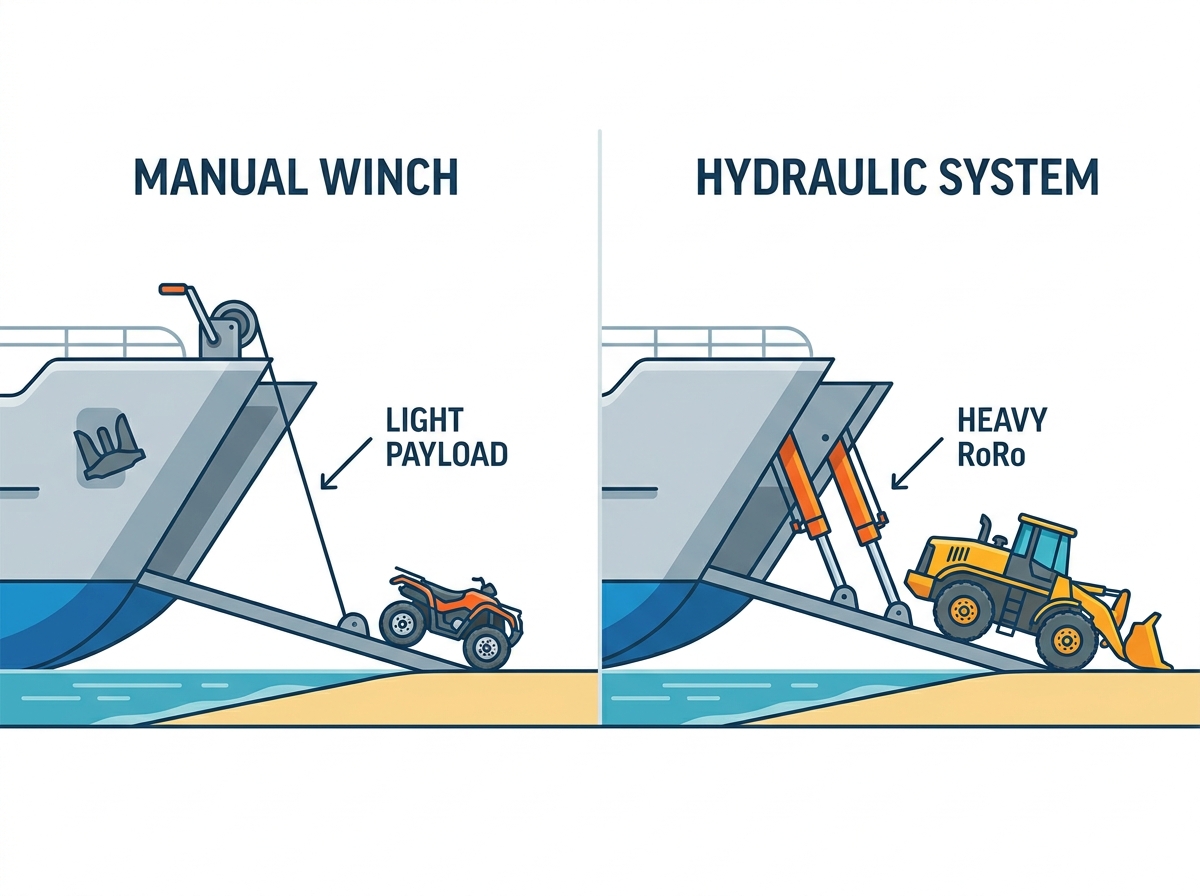
The bow ramp serves as the functional heart of your vessel. Door mechanics dictate what you can actually haul. You generally choose between manual winches and hydraulic systems.
Manual winch systems are highly cost-effective. They require much lower maintenance over time. A manual setup works perfectly for lighter payloads. Many recreational users prefer this simplicity. However, commercial operations usually require something stronger. Hydraulic systems become essential for heavy vehicle loading. They handle frequent, daily operational cycles effortlessly. You must monitor hydraulic systems for potential failure points. Fluid leaks and blown seals can stop operations entirely. Routine fluid maintenance prevents unexpected downtime.
You must evaluate necessary door width and ramp length carefully. A ramp too short creates a steep loading angle. This steep angle causes wheeled equipment to high-center during deployment. You want a seamless transition from deck to shore. Measure your longest vehicle wheelbase. Calculate the exact break-over angle required. Customizing the ramp length prevents damaging expensive UTVs or loaders during shore deployment.
Water integrity keeps your deck clear and safe. You must assess the reliability of heavy-duty marine gaskets. Water pressure constantly tests these seals during transit. Dog-down latches pull the door tight against the hull. They compress the rubber gaskets to form a watertight barrier. High-capacity scupper designs remain equally important. Scuppers allow any shipped water to drain quickly. A flooded deck compromises vessel stability instantly. You must ensure scuppers match your operational water conditions.
Hull engineering determines long-term survival in harsh environments. You must balance structural integrity against total vessel weight. Overbuilding adds unnecessary draft. Underbuilding invites catastrophic failure.
Marine-grade 5086 aluminum serves as the undisputed industry standard. It resists saltwater corrosion exceptionally well. You must decide between 1/4-inch or 3/16-inch bottom plating. A 1/4-inch bottom withstands brutal, daily beaching. A 3/16-inch bottom saves weight for lighter duties. Extruded chines add immense strength to the hull sides. Reinforced beaching plates protect the bow entry point. They take the primary impact against gravel and rock.
Deadrise angle dictates how your hull interacts with water and land. You must choose between flat bottom and semi-V designs. A flat bottom excels in extremely shallow water. It slides onto beaches easily. However, flat bottoms pound heavily in choppy bay waters. A semi-V design cuts through rough water much better. It provides a smoother ride for passengers and cargo. The trade-off is a deeper draft and a steeper beaching angle.
Deadrise Geometry Comparison
Design Type | Draft Depth | Rough Water Handling | Beaching Capability |
|---|---|---|---|
Flat Bottom (0 Degrees) | Ultra-Shallow | Poor (Pounding) | Excellent |
Shallow V (8-12 Degrees) | Moderate | Acceptable | Very Good |
Deep V (15+ Degrees) | Deepest | Excellent | Fair |
Your propulsion choice impacts usable deck space and draft. Outboard motors remain popular for their ease of service. They trim up completely for shallow beaching. Inboard jet drives offer extreme shallow water capabilities. They eliminate exposed props entirely. However, jets lose some efficiency carrying massive loads. You must evaluate power-to-weight ratios based on the maximum intended payload. Do not calculate horsepower needs based only on the dry hull weight. A fully loaded Landing Craft handles entirely differently than an empty one.
Deck layout customization maximizes your daily workflow efficiency. Where you place the helm changes everything about the boat.
You have three primary options for helm placement. Each serves a distinct operational style.
Center Console: Provides a 360-degree walkaround. Great for visibility and balancing loads.
Side Console: Pushes the helm to the starboard or port side. This maximizes linear deck space for long cargo like lumber or pipes.
Full Cabins: Placed forward or aft. They provide essential weather protection for crew and sensitive electronics.
Heavy machinery requires robust tie-down systems. You cannot rely on standard cleats. Integration of flush-mounted D-rings keeps the deck clear of tripping hazards. L-track tie-down systems offer infinitely adjustable securing points. Reinforced deck plating is non-negotiable for point-loading heavy machinery. A mini-excavator exerts massive pressure through small steel tracks. You must add aluminum cross-members directly beneath anticipated load zones.
Consider your daily tasks before adding auxiliary features. Davit cranes assist in hauling pots or loading engine blocks. Push knees allow the vessel to maneuver small barges. High-pressure washdown pumps keep the deck free of mud and debris. Specialized gunwale heights protect passengers or allow easier side-loading. Every add-on increases weight, so choose only what your mission requires.
Buying a custom vessel requires patience and realistic budget planning. This process differs entirely from purchasing off a showroom floor.
Custom builds typically require six to twelve months. This timeline starts from blueprint approval, not the first handshake. Engineering drawings take time to perfect. Sea trials occur at the very end of the process. You must discuss supply chain risks early. Specialized marine engines often face backorders. Heavy-duty hydraulics can also bottleneck production. Constant communication with your builder keeps expectations grounded.
Budgets inflate quickly in a few specific areas. You should identify these early. Cabin electronics packages can easily double in cost. Radar, sonar, and thermal imaging add up fast. Upgraded hydraulic power units (HPUs) cost significantly more than manual winches. Thicker hull plating increases material costs and welding time. Stick to your core operational needs to control the final price.
Commercial operators must navigate strict marine regulations. The United States Coast Guard (USCG) enforces rigorous standards. You must certify the vessel for commercial use if carrying paying passengers. USCG Subchapter T or K regulations dictate safety gear, hull integrity, and stability tests. Compliance influences passenger capacities directly. It also dictates stringent buoyancy requirements. Factoring in these regulations during the initial engineering phase saves massive headaches later.
A well-specced custom vessel bridges the gap between a standard boat and a commercial barge. It provides unmatched versatility for challenging marine environments. You must prioritize operational needs over cosmetic features. Payload capacity, shallow draft, and door width matter far more than paint colors. The right design choices ensure years of safe, reliable service. Your crew will work faster and safer on a deck built specifically for their tasks.
Your next step is clear. Sit down and compile your exact cargo dimensions. Document your absolute maximum weight thresholds. Note the specific water conditions and shorelines you face daily. Gather this data before initiating a consultation. Request a quote from a custom manufacturer only after you define these parameters. Clear requirements lead directly to accurate quotes and successful boat builds.
A: Draft depends heavily on hull design, weight distribution, and your chosen propulsion type. Jet drives generally allow shallower operation than outboards. Flat-bottom designs float higher than V-hulls. However, many custom models are engineered to operate in less than 12 to 18 inches of water, even when fully loaded with equipment.
A: The primary additions involve the specialized bow door mechanisms. You must routinely check hydraulic lines for leaks. Greasing ramp hinges prevents saltwater binding. Inspecting winch cables for fraying ensures safe loading. You also need to inspect and occasionally replace the marine weather stripping on the ramp seal to maintain a watertight deck.
A: Generally, no. Payload capacity is strictly dictated by the original hull displacement, structural stringer spacing, and integrated buoyancy design. Overloading a hull compromises both safety and regulatory compliance. Modifying a completed hull is expensive and rarely effective. This highlights the absolute necessity of specifying your maximum weight requirements correctly during the initial custom build.


